


 Chennai, April 12 : When I was 10 years old, during elections, the whole state turned into a festival. We could see politicians asking for votes, posters, painted wall arts, and all types of canvassing. Candidates would visit people’s homes, interact with them, and even share lunch. We witnessed all sorts of dramas during those times.
But now younger kids are asking whether we can cast our vote online? Time management or avoiding the hot sun? Oh, God, these kids. The electoral landscape of Tamil Nadu, India, is undergoing a significant transformation as candidates and political parties increasingly embrace digital media for their campaigns, marking a stark departure from the traditional methods that once defined the state’s political culture. This shift is not only reshaping the way campaigns are conducted but is also impacting the livelihoods of those who have long been associated with the sale of election souvenirs.
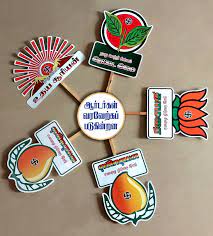
Muruganadnam, whose family has been in the business of selling election flags and political frames for three generations, is a testament to this change. With the DMK office in Chennai as his usual spot, he finds himself struggling to set up his stall due to the lack of demand for banners, flags, and small political cards, political symbol towels, and all these. “The entire campaign seems to have shrunk into mobile phones,” he laments, pointing out that the traditional campaign materials are no longer in demand.
Govindraman, a salesman at a stall near the BJP office, echoes a similar sentiment. While stickers of Modi-Anamalai are selling well, other items remain unsold. He attributes this to the cost-effectiveness and broad outreach capabilities of social media, which he believes has replaced the need for physical campaign materials. “Candidates are relying on social media to connect with voters because it does not cost money,” he explains, adding that many candidates are using audio messages on phones to campaign, which can be done from one location. Candidates think that we can reach the people’s hearts easily through social media, and they don’t want to canvass in the hot sun anymore.
This shift towards digital campaigning is not limited to the sale of election souvenirs but is also affecting the visibility of campaign rallies in the constituencies. Candidates and political parties are turning to online platforms to address voters, with some even attempting to conduct virtual meetings to connect with people in different villages.
The trend towards digital campaigning is seen as a direct result of the COVID-19 pandemic, which has forced political parties to adapt to new ways of reaching out to voters. However, the shift is also a reflection of Prime Minister Narendra Modi’s Digital India campaign, which has made everyone more tech-savvy, including political candidates.
As Tamil Nadu prepares for its elections, the use of social media and digital platforms is expected to continue to grow, marking a new era in the state’s political history. While the traditional methods of campaigning with banners, flags, and rallies are fading away, the digital revolution is bringing about a new era of political engagement, where candidates can connect with voters in ways that were previously impossible.
The impact of this shift on the traditional businesses associated with election campaigning remains to be seen, but it is clear that the future of political campaigning in Tamil Nadu, and perhaps across India, is digital.