


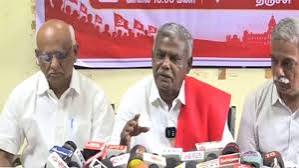
Chennai, Sept 15
The decision of the CPI and CPI(M) to join hands and contest the Dharapuram and Madurantakam by-elections under a separate Left Front has added a new layer to an already multi-cornered contest in Tamil Nadu.
While the CPI will contest Dharapuram and the CPI(M) Madurantakam, both parties have made it clear that they will continue their outside support to the ruling TVK government. The move effectively separates their electoral strategy from their legislative support, creating an unusual political equation in which the Left will oppose TVK candidates in the bypolls while helping sustain the government in the Assembly.
Political analysts see the move primarily as an attempt by the Left to retain its independent political identity rather than remain completely dependent on a larger alliance. “For the Left parties, this is less about winning two seats and more about demonstrating that they retain an electoral space of their own. Contesting together gives them an opportunity to measure their independent strength after the Assembly elections,” an analyst tracking Tamil Nadu politics said.
The two parties had won two seats each in the 2026 Assembly election, but their decision to stay away from the recently formalised TVK-led alliance has underlined their desire to maintain organisational and ideological autonomy.
The immediate beneficiary could be the Left Front itself if the contest succeeds in consolidating its traditional vote pockets. A joint campaign avoids the possibility of the two Communist parties dividing their limited vote share between themselves.
“The real gain for the Communists is not necessarily the number of votes but the political visibility that comes from fighting as a common front. A respectable vote share in either constituency could become a bargaining chip in future alliance negotiations,” another political analyst observed. However, the arithmetic is equally challenging. With TVK, DMK, AIADMK-led forces and NTK also in the field, the Communist vote could remain too small to cross the winning threshold unless the party succeeds in converting its cadre strength and issue-based appeal into votes.
For TVK, the Communist decision is a potential setback, but not necessarily a major electoral threat. The Left parties’ decision denies Vijay’s party the symbolic advantage of having all parties extending support to his government also backing its candidates in the bypolls.
“TVK can no longer project the Left parties as part of its electoral camp. At the same time, the Communists continuing to support the government makes it difficult for TVK to portray them as outright political adversaries,” the analyst said. This contradiction could become a talking point during the campaign, particularly if TVK attempts to turn the bypoll into a referendum on its first few months in power.
The biggest potential loser could be the DMK if the Left vote, traditionally associated with the DMK-led alliance, moves even partially towards independent Communist candidates. In a close three- or multi-cornered contest, even a few thousand votes can alter the final result.
“The Left may not have the numbers to win, but it has enough of a vote base in some areas to influence the winner. That makes its decision more consequential for DMK and TVK than the raw vote share would suggest,” a political observer said. The DMK, therefore, faces the challenge of retaining its traditional Left-leaning voters while simultaneously fighting TVK and AIADMK.
AIADMK too has reasons to watch the Communist contest carefully. A division of anti-incumbent or non-TVK votes could work to its advantage in a close race, particularly if the Left remains outside the principal alliances. But if the Communist candidates succeed in attracting sections of workers, farmers and traditional Left voters, they could also complicate the AIADMK’s attempt to consolidate the opposition vote. The outcome will therefore depend not merely on which party wins the Communist vote, but on which major party loses enough votes because of its presence.
The larger political message, however, goes beyond the two by-elections. The Left parties are attempting to preserve maximum room for manoeuvre: support the TVK government where they believe stability and secular politics require it, while refusing to surrender their independent electoral identity. “The Communists are keeping two doors open. They are willing to support the government on issues of stability and governance, but they do not want that support to become an electoral merger with TVK. The bypolls are their way of testing how much political space they can retain outside the emerging TVK-led bloc,” the analyst said.
For TVK, the bypolls will test whether its Assembly numbers and alliance structure can translate into ground-level electoral strength. For the DMK, they will indicate whether its traditional support base remains intact outside the old alliance framework.
For AIADMK, the contests will show whether it can benefit from an anti-TVK vote without a broader consolidation. And for the Left, the two seats could become a test of relevance itself. In that sense, Dharapuram and Madurantakam are not merely by-elections; they are early indicators of how Tamil Nadu’s new multi-polar political landscape is beginning to settle.