

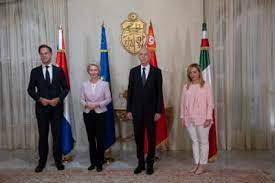
 Tunisia is hosting the leaders of Italy, the Netherlands and the , on Sunday for talks aimed at smoothing the way for an international bailout and restoring stability to a country that has become a major source of migration to Europe. Tunisia’s increasingly autocratic president is balking at conditions for USD 1.9 billion in stalled International Monetary Fund support, which include cuts to subsidies on flour and fuel, cuts to the large public administration sector, and the privatisation of loss-making public companies. President Kais Saied warns such moves would unleash social unrest, and bristles at what he calls Western diktats. But Tunisia’s economy is teetering toward collapse. The population is already restive, and disillusioned with both Saied’s leadership and the country’s decade-long experiment with democracy. That has pushed more and more Tunisians to risk dangerous boat journeys across the Mediterranean to seek a better life in Europe. Tunisia is also a major transit point for others seeking to migrate: sub-Saharan Africans make up the majority of those who leave from Tunisia’s shores, including some who fled racist abuse stoked by the Tunisian president earlier this year. “Tunisia is a priority, because destabilisation in Tunisia would have serious repercussions on the stability of all Northern Africa, and those repercussions inevitably arrive here,” Italian Premier Giorgia Meloni, whose country is the destination for most Europe-bound migrants leaving from Tunisia, said Thursday.
European leaders hope to restore stability in Tunisia
 By Agency
🌐 Translate ▾
- Tamil
- Hindi
- Malayalam
- Kannada
- Telugu
Add A Comment