

Chennai, Nov 18:
The controversy surrounding Thirupparankundram hill in Madurai has evolved from a dispute over a traditional observance into a larger debate about religious rights, historical ownership, judicial authority and the Tamilnadu government’s approach to matters of faith. At the centre of the controversy is a seemingly simple question: can devotees light the Karthigai Deepam at an ancient stone pillar, known as the Deepathoon, on the hill?
For devotees, the issue goes beyond the lighting of a lamp. It concerns the right to practise their faith without unnecessary administrative restrictions. The dispute has also acquired political significance, with Hindu organisations questioning whether the State has been sufficiently sensitive to the religious sentiments of the majority community.
Thirupparankundram occupies a special place in Tamil religious tradition. The Subramaniya Swamy Temple situated at the foothills is revered as one of the six sacred abodes of Lord Murugan. The hill also carries significance for Jain and Muslim communities, with ancient Jain remains and the Sikandar Badusha Auliya Dargah forming part of its landscape.
The dispute cannot be understood without examining its legal history. Litigation over ownership of the hill dates back to the early twentieth century. A civil court judgment in 1923, subsequently restored by the Privy Council in 1931, recognised the temple’s ownership over substantial portions of the hill while protecting the dargah and its associated areas. This distinction is important because any discussion about religious rights must also respect legally recognised property boundaries.
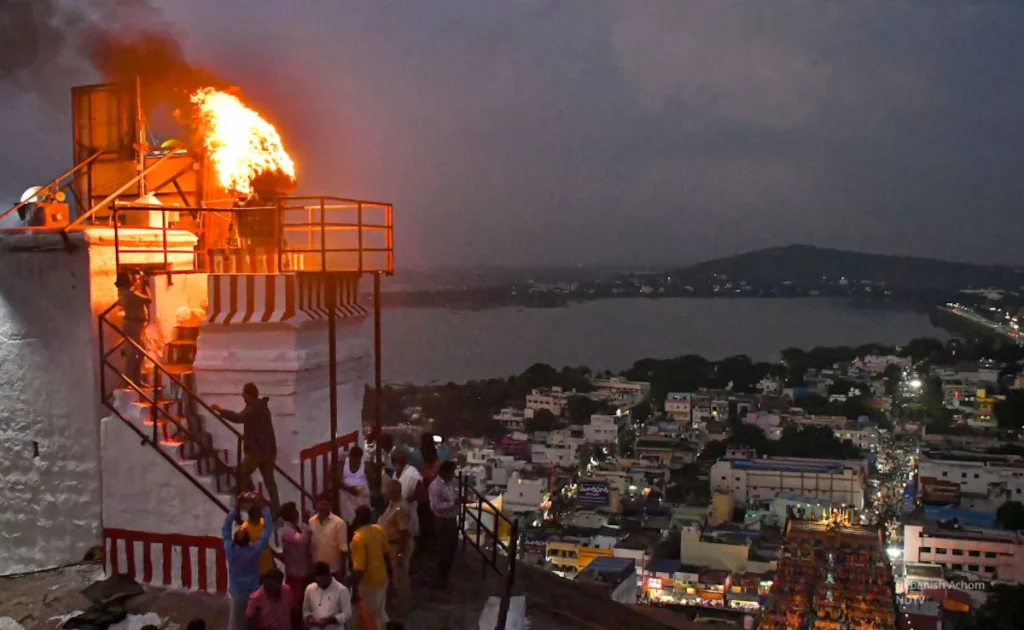
The immediate controversy concerns the location of the Karthigai Deepam. The temple administration has conducted the lamp-lighting ceremony at the Deepa Mandapam near the Uchipillaiyar Temple. Hindu devotees and organisations, however, have sought permission to light the lamp at the Deepathoon, a stone pillar located approximately 50 metres from the dargah.
The issue gained fresh momentum in December 2025 when Madras High Court Justice G R Swaminathan permitted the lighting of the lamp at the disputed location. The judge held that preventing devotees from exercising their religious rights required justification, particularly when the proposed observance did not interfere with the dargah’s rights.
The State administration’s reluctance to implement the order triggered further legal proceedings and protests. The matter subsequently reached a Division Bench of the Madras High Court, which on January 6, 2026, upheld the permission to light the Deepam at the pillar. The court also observed that administrative prohibitory orders could not automatically override an essential religious practice.
The State, however, challenged the decision before the Supreme Court. The controversy has since taken another turn, with the Tamilnadu government opposing a separate plea seeking Archaeological Survey of India control over the temple and the hill, as well as broader changes to the Deepam arrangements.
In its latest submissions before the Supreme Court on November 17, the State argued that there was no established custom of lighting the lamp at the disputed pillar. It maintained that the traditional practice had been followed near the Uchipillaiyar Temple for generations and cited the views of temple functionaries and earlier judicial proceedings. The government also raised concerns about maintaining public order.
The Supreme Court bench comprising Justices Aravind Kumar and Vipul M Pancholi heard the State’s arguments but did not announce an interim decision on November 17. The hearing is scheduled to continue today, ahead of the Karthigai Deepam observance on November 24.
The government’s position deserves judicial examination, particularly on the question of historical custom. However, public order cannot become a convenient justification for indefinitely restricting a community’s religious aspirations. If a proposed religious observance does not infringe upon another community’s legally protected rights, the administration should explore ways to facilitate it peacefully rather than allowing apprehensions to become permanent barriers.
The Thirupparankundram dispute therefore presents an opportunity for the judiciary and the administration to establish a fair precedent. Historical records, property rights, established customs and constitutional freedoms must all receive careful consideration.
Ultimately, a lamp should not become a symbol of confrontation. It should represent the freedom to practise one’s faith with dignity. The challenge before the State is to ensure that protecting communal harmony does not come at the cost of denying legitimate religious rights.
The flame of Karthigai Deepam has traditionally symbolised the triumph of light over darkness. At Thirupparankundram, its larger significance may now lie in whether constitutional fairness, mutual respect and religious freedom can prevail over mistrust and political confrontation.