

Beijing, Nov 26:
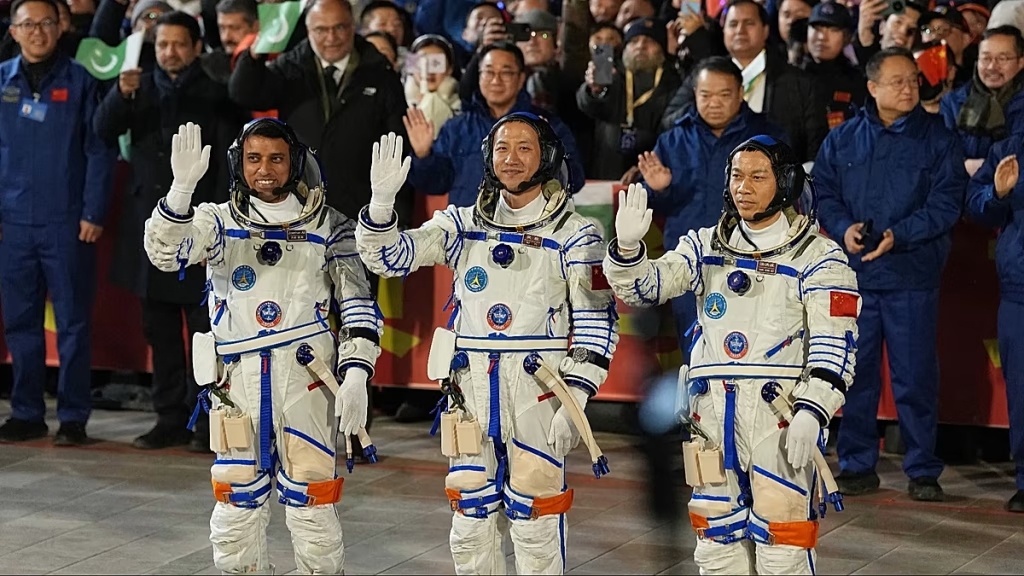
China has successfully launched its Shenzhou-24 crewed spacecraft carrying three astronauts, including Pakistani national Muhammad Zeeshan Ali, marking a significant development in its international space cooperation programme.
The spacecraft was launched aboard a Long March-2F rocket from the Jiuquan Satellite Launch Centre in northwestern China on Wednesday. Chinese space authorities confirmed that the launch was successful and that the crew was in good condition.
Ali’s participation makes him the first foreign national to take part in China’s crewed space programme and visit its Tiangong space station.
The mission also carries symbolic importance as China and Pakistan mark 75 years of diplomatic relations. The two countries have maintained close ties in defence, economic cooperation and strategic affairs.
Chinese President Xi Jinping and Pakistani President Asif Ali Zardari exchanged congratulatory messages following the launch.
In his message, Xi described the joint space mission as an important achievement in bilateral cooperation and a reflection of the longstanding friendship between the two countries. He also expressed China’s willingness to expand peaceful space exploration with Pakistan and other international partners.
The Shenzhou-24 crew comprises mission commander and spacecraft pilot Tang Hongbo, flight engineer Wu Yi and Ali, who has been assigned the role of payload specialist.
Approximately 10 minutes after liftoff, the spacecraft separated from the launch vehicle and entered its designated orbit, according to the China Manned Space Agency.
The spacecraft subsequently completed its docking with the Tiangong space station. The three incoming astronauts then entered the orbital facility and joined the existing crew, which had been stationed there for the previous six months.
Ali’s participation represents an important step in China’s efforts to broaden international involvement in its space programme. It also provides Pakistan with an opportunity to deepen its scientific and technological cooperation with Beijing.
The mission highlights the growing role of international partnerships in human spaceflight, while strengthening the strategic relationship between the two neighbouring countries.