

New Delhi / Madurai, Nov 27:
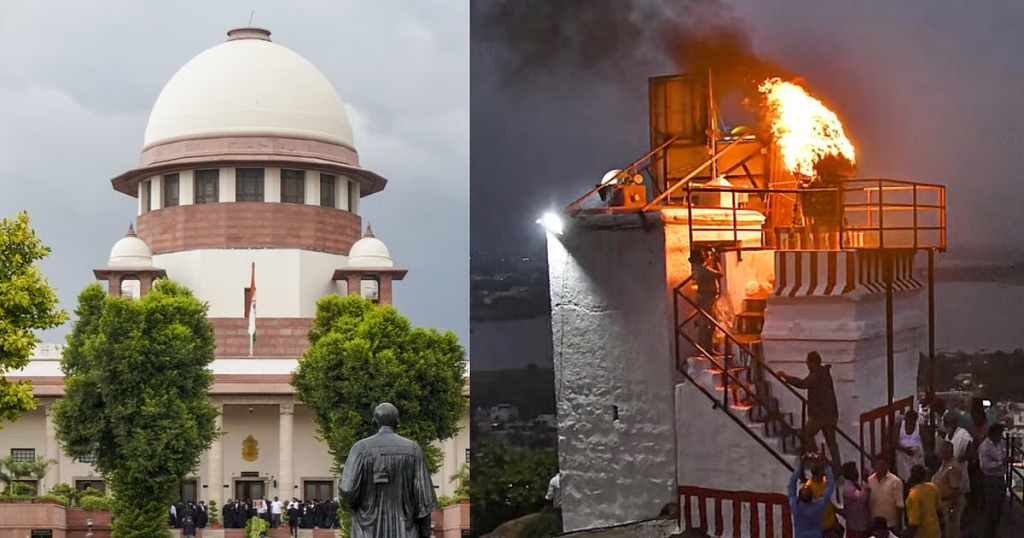
The Supreme Court turned up the heat on the Tamil Nadu government and temple authorities while hearing contempt petitions over the failure to light the Karthigai Deepam at the Deepathoon pillar atop Thiruparankundram hill on November 24 despite the court’s one-time permission.
Clarifying at the outset that it would confine itself strictly to the alleged disobedience of its November 20 directive, a bench of Justices Aravind Kumar and Vipul M. Pancholi observed, “We want to make it clear to both sides that we are not going into the main matter. Only with regard to the orders of this court dated 20/11/2026 not complied with — only that limited issue we are hearing today. Nothing more, nothing less.”
Appearing for contempt petitioner Karthikeyan, Senior Advocate S. Guru Krishnakumar described the state’s preliminary report as “like a confession,” arguing that authorities “did everything except for the lamp being lit.” He submitted that the temple’s Board of Trustees was bound by the court’s order and noted that the sthanikas had come forward to state they were never consulted, calling the Collector’s explanation an “incredible, unacceptable excuse” and a “gross case of contempt.” Senior Advocate J. Sai Deepak, representing Hindu Munnani leader Rama Ravikumar, questioned the timing of the five-member board’s appointment on November 13 under the HR&CE Act, alleging a premeditated plan to defy the court’s order while using the trustees as a shield.
Solicitor General Tushar Mehta, appearing for the Archaeological Survey of India (ASI), informed the bench that ASI officials were stopped by Tamil Nadu police at 3 pm on November 24 and barred from approaching the ceremonial site. “My respectful submission is… this is a case of aggravated contempt and administrative arrogance. The government has been opposing from the beginning,” Mehta said, urging the court to direct the alleged contemnors to purge the contempt by lighting the lamp before being heard and suggesting another agency monitor implementation.
While Senior Advocate Gopal Sankaranarayanan, appearing for the Madurai District Collector, disputed the claim that the temple’s Executive Officer had signed the trustees’ resolution and reiterated that arrangements had been made awaiting board authorisation, Senior Advocate Abhishek Manu Singhvi appeared virtually for the HR&CE Commissioner. Reacting to Singhvi’s appearance, the bench remarked, “That’s the main person who is in trouble!”
Counsel for the Hazrat Sultan Sikandar Badusha Auliya Dargah opposed the Hindu worshippers’ demand and submitted that it had not been served copies of the contempt petition, while the state noted it had received only one of the two contempt pleas. Declining to initiate suo motu contempt proceedings while stating it would hear formal pleas once verified by the registry, the bench continued examining whether state officials wilfully disobeyed its directive.