

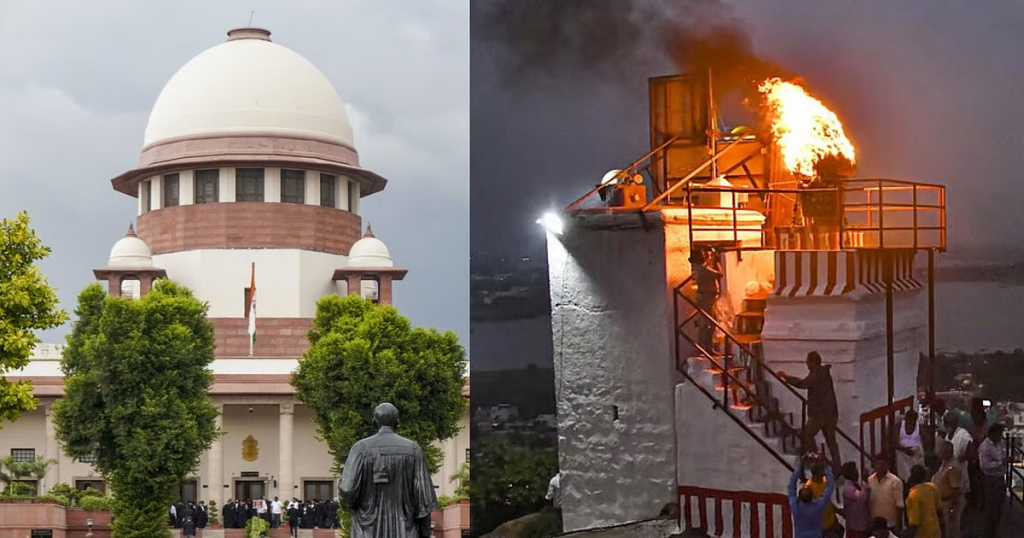
Taking strong exception to the non-implementation of its earlier directive, the Supreme Court on Friday ordered that the Karthigai Deepam be lit atop the Deepathoon stone pillar on Thiruparankundram Hill in Madurai district on Saturday, November 28, while suspending the board of trustees of the Arulmigu Subramaniaswamy Temple.
A Bench of Justices Aravind Kumar and Vipul M. Pancholi described the failure to light the ceremonial lamp on November 24—despite an interim order passed on November 20—as “wilful” and “flagrant disobedience.” Observing that the sequence of events reflected “administrative chaos,” the court placed the temple’s administration under court-appointed receivers and handed over security of the hill, the temple, and the nearby dargah to the Central Reserve Police Force (CRPF).
To oversee the ritual and manage temple affairs, the Bench appointed retired Madras High Court judges Justice S. Vaidyanathan and Justice V. Parthiban as receivers. The court directed that the lamp be lit at the designated Deepathoon location—situated roughly 50 metres from the dargah—on Saturday using the sacred flame from the Uchi Pillaiyar temple.
Tamil Nadu’s Director General of Police, the Inspector General of Police, and the Madurai Superintendent of Police have been instructed to ensure a smooth handover of security arrangements to the CRPF. The court also asked the state government to provide necessary logistical assistance to the receivers so that the ritual proceeds without obstruction.
Finding a prima facie case of contempt over the November 24 lapse, the Bench issued contempt notices to senior state and district officials, including the Madurai District Collector and top police officers, directing them to appear personally before the court on December 15.
The dispute stems from petitions seeking permission to light the Karthigai Deepam at the Deepathoon pillar rather than solely at the traditional Deepa Mandapam near the Uchi Pillaiyar temple. A single judge of the Madras High Court had ruled in favour of lighting the lamp at the stone pillar in December 2025, a verdict upheld by a division bench in January 2026 subject to consultations with the Archaeological Survey of India and police authorities.
While the state government and temple administration had challenged the move citing established custom as well as heritage and law-and-order concerns, the apex court had on November 20 granted a one-time interim permission for the ritual on November 24, leaving the broader legal validity of the High Court’s ruling to be heard in January 2027.