


New Delhi, Sept 1:
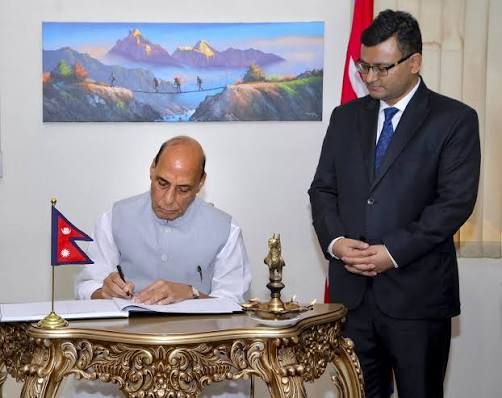
Defence Minister Rajnath Singh on Monday assured Nepal of India’s continued support for search, rescue, relief and rehabilitation efforts following the devastating flash floods that have caused widespread destruction and loss of life in the neighbouring country.
Singh described India and Nepal as close friends and said India would stand with Nepal during the crisis. He expressed condolences to the people affected by the disaster while visiting the Nepalese Embassy in New Delhi and signing the condolence book.
The August 26 disaster has affected several parts of Nepal, including areas near the Nepal-Tibet border. The floods and associated landslides have caused extensive damage to houses, roads, bridges and hydropower infrastructure.
Nepal’s government has said that saving lives, locating missing persons, conducting rescue operations and providing urgent relief remain its immediate priorities.
India has already extended specialised assistance to the ongoing operation. This includes a tunnel-rescue team and a forensic team specialising in DNA analysis to help identify victims.
According to Nepal’s Ministry of Foreign Affairs, an 18-member Indian forensic team specialising in DNA analysis has been working in the country since August 29. Indian and Chinese specialist teams are also involved in tunnel-rescue operations.
India has also supplied relief and emergency equipment as part of the international response to the disaster.
Nepal said it had received support from several countries, including India, China, Japan, the United States, the UAE and South Korea. Supplies include generators, solar lamps, DNA testing kits, emergency equipment, tents, blankets, sleeping bags, food packets and medicines.
The Nepalese government has begun a preliminary assessment of the damage and said a detailed Post-Disaster Needs Assessment would be undertaken to determine the requirements for rehabilitation and reconstruction.
The scale of destruction is expected to require substantial international assistance, particularly for rebuilding damaged houses, roads, bridges and hydropower facilities.
India’s support is expected to continue beyond the immediate rescue phase, with rehabilitation and reconstruction likely to become the next major priority once search and relief operations are completed.
The disaster has also affected foreign nationals, including Indians, prompting Indian authorities and State governments to coordinate with Nepal and local administrations to trace missing persons and facilitate evacuations.