


Chennai, Sept 23:
Tamil Nadu could face excess rainfall and flooding during the northeast monsoon between October and December, followed by water scarcity and drought stress in some areas next year, according to the preliminary assessment of an expert committee constituted by the State Government to study the impact of the Super El Nino system.
The committee, headed by Dr Sivananda Pai, head of the Regional Meteorological Centre, Chennai, has advised the government to prepare for contrasting weather risks during 2026 and 2027. Its preliminary report was recently submitted to Chief Minister C Joseph Vijay.
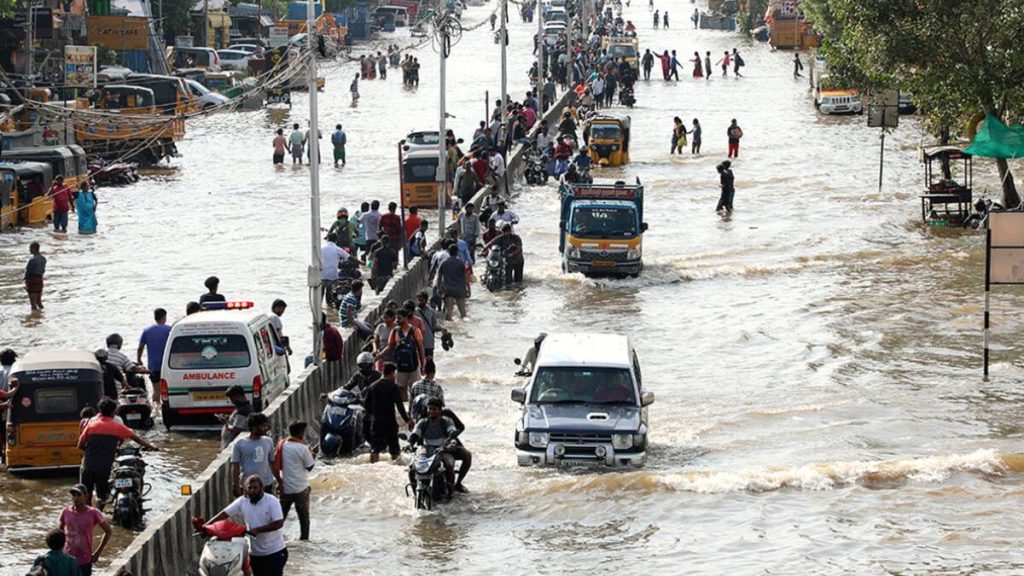
The panel has assessed the possibility of excess rainfall over the southern peninsular region during October-December and called for advance preparedness for heavy rain, urban flooding and riverine flooding during the northeast monsoon.
At the same time, the committee cautioned that rainfall may not be evenly distributed across Tamil Nadu. Regions receiving deficient or uneven rainfall could face water scarcity, reduced reservoir inflows and drought stress. It has therefore recommended that preparations should address both flood and drought scenarios rather than focusing exclusively on one.
The committee has also identified heatwave and heat stress during the summer of 2027 as a major concern. Its recommendations cover agriculture, horticulture, livestock, fisheries, coastal and marine systems, public health, energy demand, critical infrastructure and essential services.
The panel has proposed a three-stage preparedness framework. Short-term measures are to be completed before the northeast monsoon, medium-term measures before next summer and long-term measures progressively over the next three to five years.
The report also cautions against assuming that an El Nino automatically means drought for Tamil Nadu. Historical rainfall data show that El Nino years can also witness normal or above-normal northeast monsoon rainfall in the southeastern peninsula. An IMD assessment covering 1940-2021 found that northeast monsoon rainfall during El Nino years was excess in 28 per cent of the years, above normal in 57 per cent and deficient in 15 per cent.
The committee cited 2005 as an example of extreme rainfall occurring alongside warm El Nino-like conditions. Tamil Nadu recorded 79 per cent excess rainfall between October and December that year, with repeated depressions and cyclonic systems over the Bay of Bengal contributing to heavy rainfall.
The ECMWF Seasonal Forecast System 5, issued in August 2026 for October-December, has indicated above-normal precipitation over Tamil Nadu and neighbouring southern regions, with forecast anomalies broadly in the range of 50-200 mm in parts of the region.
However, the committee has stressed that seasonal forecasts should not be interpreted as predictions of individual rainfall events. Short-duration extreme rainfall, cyclones and dry spells will continue to depend on evolving weather systems and regional conditions.
The Disaster Management Department has been advised to establish a multi-hazard monitoring, early-warning and early-action system. The proposed framework includes hazard indicators, predefined thresholds and actions, nodal officers, data-quality checks, Tamil-first dashboards and alert dissemination mechanisms.
District- and block-specific impact-based warnings have also been recommended through SMS, radio, WhatsApp and social media. Drones have been suggested for surveillance, search and rescue operations and rapid damage assessment.
The committee has separately called for drought preparedness, including measures for reservoir management and water availability in areas where rainfall is deficient. It has also recommended heat-safety measures in schools, including awareness programmes, adjustments to outdoor activities and school timings during extreme heat, and the use of cool roofs and reflective coatings in vulnerable schools.
The panel has said the State should continuously monitor El Nino-Southern Oscillation conditions, seasonal forecasts and actual weather impacts and periodically revise preparedness measures.