


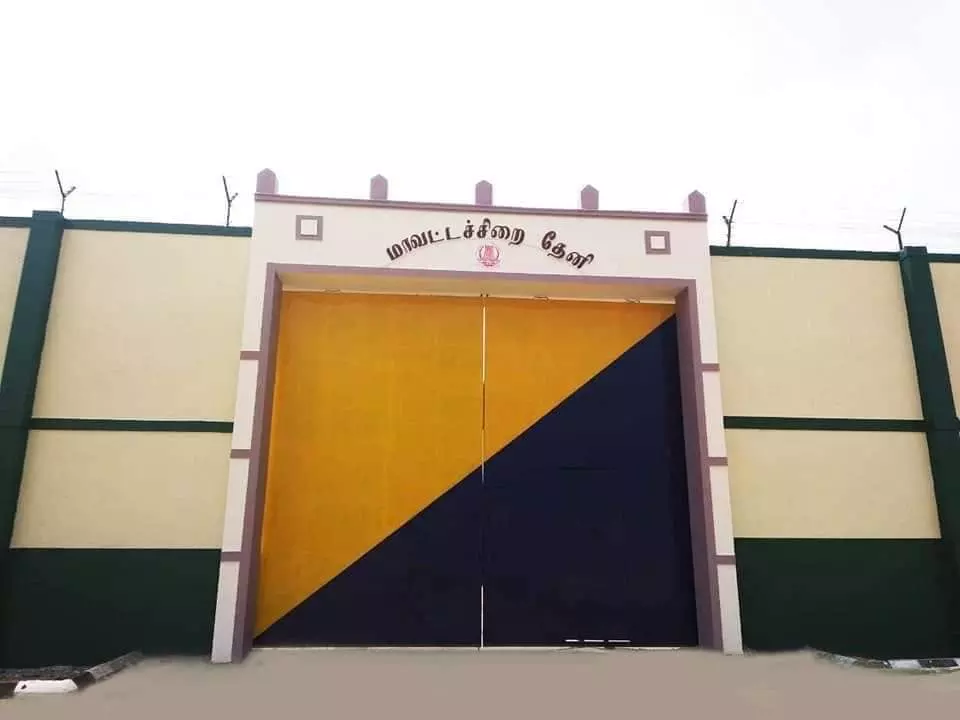
CHENNAI:
The escape of 17 undertrial prisoners from the Thekkampatti district jail near Andipatti in Theni district on Monday night has brought Tamil Nadu’s history of prison breakouts back into focus, reviving memories of some of the most audacious escapes in the State’s recent past.
The incident, in which the inmates allegedly overpowered prison personnel and fled after staging what appeared to be a medical emergency, has exposed serious lapses in prison security. By Tuesday evening, 13 of the 17 escapees had been recaptured, while police continued efforts to trace the remaining four. Nine prison personnel were suspended for alleged dereliction of duty.
According to preliminary reports, the escape began when an inmate allegedly pretended to suffer an epileptic seizure. A guard who entered the overcrowded cell to attend to the emergency was attacked, and the prisoners allegedly gained access to the keys before escaping through the main entrance. Reports subsequently pointed to inadequate staffing, unmanned watchtowers and gates that had not been secured according to protocol.
The scale of the breakout has prompted a review of prison security across the State. The Prisons Department has announced the deployment of armed guards at watchtowers in central and district prisons, along with the activation of alarms and a review of security procedures.
Vellore Fort escape: 43 suspected LTTE cadres
One of the most notorious prison escapes in Tamil Nadu occurred at Tipu Mahal inside Vellore Fort in August 1995. As many as 43 suspected cadres of the Liberation Tigers of Tamil Eelam (LTTE), who were being detained at the facility, escaped in a carefully planned operation that stunned the State police.
The detainees had reportedly spent years at the facility and were familiar with its routines. According to accounts of the incident, they used improvised tools made from bathroom pipes and steel food plates to dig a tunnel measuring about 153 feet. The tunnel ran approximately 10 feet below the surface, and the escapees reportedly crossed the moat surrounding the fort after emerging outside the walls.
The operation was carried out over three nights, between August 12 and 14, with rain and power cuts believed to have helped the escapees evade detection. The failure of the security arrangements came under scrutiny, particularly because sentries in watchtowers and other personnel had been assigned to guard the facility.
The aftermath was equally dramatic. Police managed to recapture 11 of the 43 escapees, while the others reportedly made their way back to Sri Lanka. One suspected militant died after consuming cyanide when confronted by police in Chennai on Independence Day. The episode remains a landmark example of how planning, familiarity with security routines and lapses in supervision can combine to facilitate a mass escape.
Chennai Central Prison breakout in 1995
Earlier in February 1995, another major escape attempt took place at the old Chennai Central Prison, which stood opposite Chennai Central railway station before the facility was shifted to Puzhal.
According to accounts of the incident, 15 inmates were involved in the attempt, during which they seized weapons from prison guards and tried to scale the compound wall. Nine managed to escape. Three others reportedly suffered broken legs, while three were stranded in the Cooum river.
The incident was among several prison escape attempts reported in Tamil Nadu during the first half of the 1990s. The frequency of such episodes prompted closer attention to prison security and the need to strengthen surveillance, staffing and physical barriers.
Puzhal escape attempt highlights individual security breaches
Prison security concerns have persisted even after major facilities were upgraded. In July 2018, a prisoner named Rajesh, who had been lodged at Puzhal Central Prison in connection with a theft case, went missing from his cell within days of his admission.
A search led prison staff to the library roof, where he was found trying to work out a way to escape. Although the attempt failed, the episode demonstrated how an inmate could exploit gaps in supervision and move through parts of a prison complex without immediately being detected.
The incident was different in scale from the mass breakouts of 1995, but it underscored the continuing need for effective monitoring, regular inspections and alert personnel.
Security protocols under scrutiny
The Theni incident has once again raised questions about whether prison security arrangements are being implemented effectively on the ground. While physical infrastructure, watchtowers and alarms are important, their effectiveness depends on adequate staffing, adherence to procedures and the ability to respond to emergencies without compromising security.
The reported use of a medical emergency as a diversion also highlights the challenge prison staff face in balancing inmate welfare with security. Emergency calls must be attended to promptly, but established safeguards cannot be abandoned in the process.
The proposed deployment of armed guards and a review of standard operating procedures could strengthen security. However, the immediate priority is to establish how the Theni inmates managed to overpower the staff, gain access to keys and leave the premises, and why basic safeguards failed.
From the tunnel at Vellore Fort to the escape through the main gate at Thekkampatti, the circumstances of Tamil Nadu’s major prison breakouts have differed sharply. Yet the recurring lesson is that even elaborate security arrangements can be undermined when routine checks, staffing and operational protocols fail.