


Chennai,Oct 29:
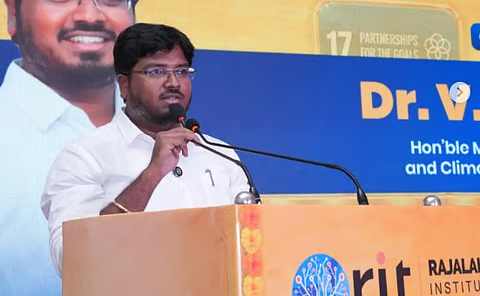
Tamil Nadu Environment Minister V K Rajeev has come under criticism after attributing river foam primarily to domestic sewage containing detergents and other household cleaning agents, rather than industrial effluents. His explanation drew sharp reactions from Opposition leaders and revived memories of former AIADMK minister Sellur K Raju’s controversial experiment involving thermocol sheets to reduce water evaporation.
Rajeev made the remarks on Tuesday after inspecting a river affected by foaming. He said scientific studies and inspections by pollution control authorities indicated that detergents and other substances in domestic sewage could contribute to the formation of foam in water bodies.
PMK president Anbumani Ramadoss criticised the explanation, arguing that the role of industrial effluents, particularly those released by textile dyeing units into water bodies such as the Noyyal, could not be overlooked. AMMK general secretary T T V Dhinakaran also accused the government of shifting responsibility to ordinary citizens instead of adequately addressing industrial pollution.
Former AIADMK minister Sellur K Raju, who was ridiculed for his earlier thermocol experiment, joined the criticism. He reportedly mocked Rajeev’s explanation, drawing a comparison with the ridicule he had faced over his own initiative.
Defending his position, Rajeev cited a 2020 Central Pollution Control Board study of the Yamuna, which identified sewage containing surfactants, detergents and phosphorus as important contributors to foaming. He also referred to foaming at Kelavarapalli dam in Krishnagiri, which he attributed to sewage flowing from Bengaluru.
The minister further cited a Tamil Nadu Pollution Control Board inspection following a foaming incident in Vaniyambadi on October 22. According to him, the inspection identified surfactants as the cause and found no evidence of other industrial pollutants in that particular incident.
Rajeev said the government was also addressing complaints about dyeing units discharging effluents into agricultural fields in Salem. He accused previous governments of allowing industrial pollution to continue in return for money and said the present administration was acting against violations.
The government is exploring technical interventions, including bacterial and algal cultures, to improve water quality at Kelavarapalli dam. Rajeev said officials had been instructed to respond promptly to pollution complaints and prevent industrial and hazardous waste from affecting the public.
While detergents and sewage can contribute to foaming, environmental concerns over industrial discharges require site-specific investigation. The minister’s remarks have therefore renewed the debate over the need for scientific monitoring, effective enforcement and clear identification of pollution sources before responsibility is assigned.