


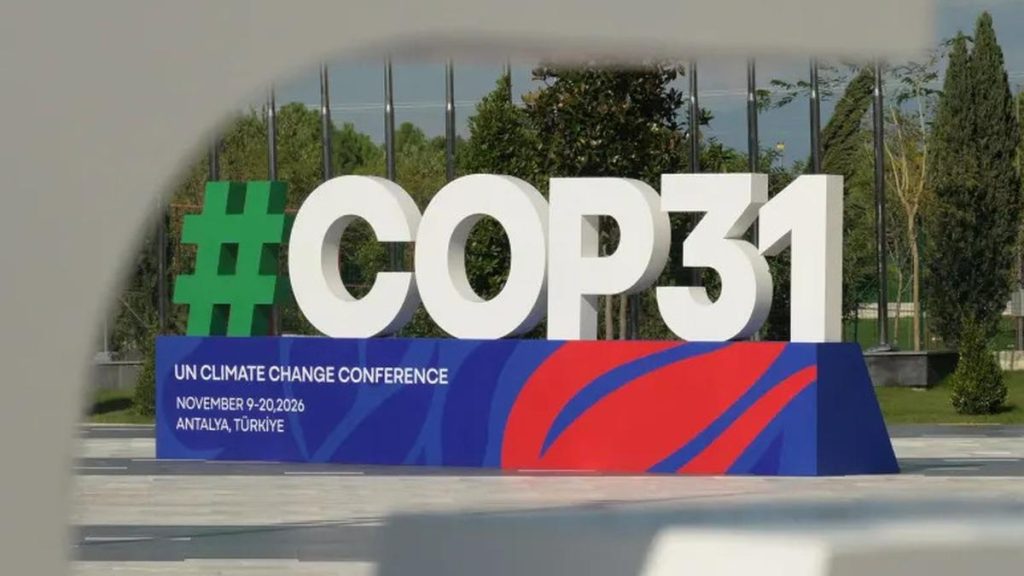
Antalaya, Nov 13:
International efforts to contain global warming have made virtually no progress over the past five years, with new climate commitments failing to produce meaningful reductions in projected temperatures, according to an independent assessment released on Thursday.
The findings were presented during a United Nations climate conference in Antalya, Türkiye, where world leaders are discussing the growing consequences of climate change and measures needed to address the crisis.
In its latest report, Climate Action Tracker said the combined impact of global climate policies had remained largely unchanged for five consecutive years, as progress in some areas was offset by setbacks elsewhere.
The report contrasted this stagnation with the initial five years following the 2015 Paris Agreement, when international climate commitments helped reduce projected global warming by approximately one degree Celsius, equivalent to 1.8 degrees Fahrenheit.
The primary driver of climate change is the accumulation of greenhouse gases in the atmosphere, largely resulting from the burning of coal, oil and natural gas. Addressing the problem requires countries to significantly reduce their annual emissions through national climate action plans, known as nationally determined contributions.
However, the latest assessment warned that the limited progress in implementing these commitments was pushing the planet towards an irreversible overshoot of the 1.5-degree Celsius warming threshold established under the Paris Agreement.
Even if countries fulfil all their existing climate pledges, global temperatures could rise by 2.6 degrees Celsius, or 4.7 degrees Fahrenheit, above pre-industrial levels by the end of this century.
Sarah Heck, a climate policy analyst at Climate Analytics and lead author of the report, said the latest commitments had failed to improve the projected warming trajectory, which remained at the same level as in 2024 and 2025.
She stressed that the existing targets were inadequate and that governments needed to adopt substantially stronger emission-reduction commitments.
Leaders of vulnerable island nations used the climate summit to underline the immediate dangers posed by rising temperatures and sea levels.
Although extreme weather events, including stronger storms, heatwaves, droughts and floods, affect countries across the world, small island nations face the additional threat of losing significant portions of their territory as sea levels rise.
Marshall Islands President Hilda Heine warned that continued investment in fossil fuel extraction posed a direct threat to the survival of vulnerable countries.
She argued that the development of new oil and coal resources should be viewed as a danger rather than an economic achievement.
Heine also recalled witnessing coral reefs that were once vibrant and healthy turn white because of bleaching this year. She called for an exceptionally strong international response to the prospect of exceeding the 1.5-degree warming threshold.
Leaders from Tuvalu, the Bahamas, Antigua and Barbuda, Niue and other island nations were also expected to reiterate the urgency of climate action during the conference.
Barbados Prime Minister Mia Mottley called on wealthy countries to move beyond announcing climate funding commitments and ensure that financial assistance actually reaches vulnerable nations.
She said developing countries needed greater support to rebuild communities affected by climate disasters and strengthen their ability to adapt to rising temperatures.
Mottley expressed concern that even the financial commitments already announced had declined significantly, with promised funding reportedly 70 per cent below earlier levels.
She emphasised that announcements and pledges could not substitute for actual financial assistance, pointing out that expressions of support at international meetings did little to rebuild homes destroyed by climate-related disasters.
The report and the statements by island leaders underline growing frustration over the gap between international climate commitments and their implementation.