

Turkey, Nov 23:
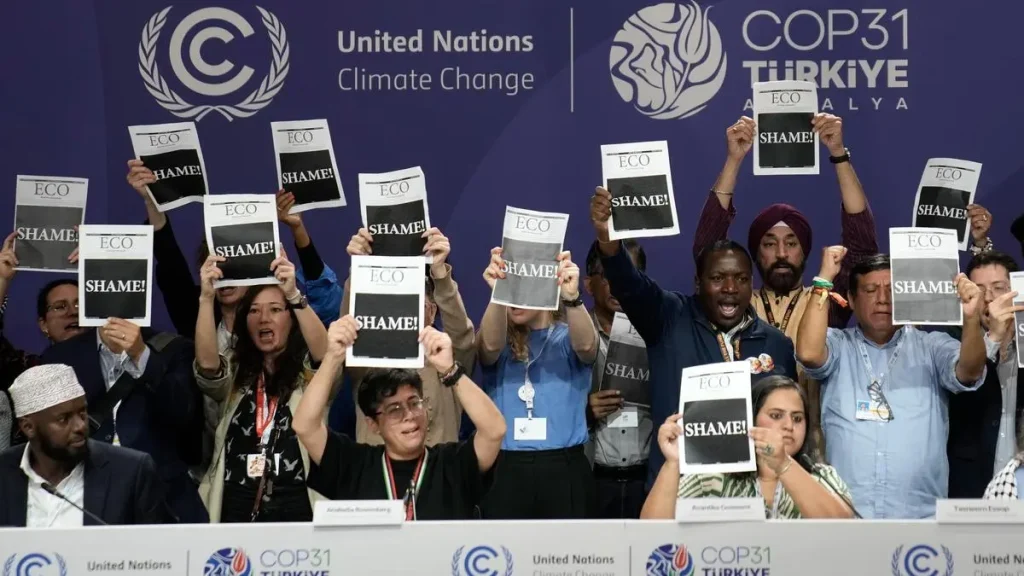
The United Nations climate conference COP31 has concluded without a comprehensive agreement after participating countries failed to resolve disagreements over the inclusion of fossil fuels in the final declaration.
The two-week negotiations in Antalya, Türkiye, ended in disappointment after divisions over climate finance, energy transition commitments and carbon capture technology prevented governments from reaching the consensus required for a common agreement.
The outcome came despite growing international pressure for stronger climate action as countries face increasingly severe heatwaves, floods, storms and droughts. The United Nations has also warned that the world is on course to exceed the temperature threshold established under the 2015 Paris Agreement.
One of the biggest obstacles during the negotiations was whether the final document should explicitly mention fossil fuels, particularly coal, oil and natural gas, as the principal drivers of global warming.
The European Union and several other countries opposed the final proposal because it did not contain a sufficiently strong reference to moving away from fossil fuels. Ireland’s Climate Minister Darragh O’Brien expressed frustration over the omission, arguing that a meaningful climate agreement could not avoid addressing the main sources of emissions.
Fossil fuels had remained largely absent from the final declarations of climate conferences for more than two decades. A significant breakthrough came at COP28 in Dubai, when countries agreed to pursue a transition away from fossil fuels. However, subsequent negotiations struggled to translate that commitment into more detailed action.
The Turkish-Australian leadership proposed retaining the Dubai language, but several countries and environmental organisations considered this insufficient.
Another major disagreement involved the draft’s support for carbon capture and storage technologies. Critics argued that giving such technologies a prominent role could allow industrial polluters to delay direct reductions in greenhouse gas emissions.
Climate campaigners and representatives of several countries also criticised the negotiation process, blaming the failure on the positions adopted by wealthier nations, fossil fuel-producing countries and the conference leadership.
The final proposal was circulated in the early hours of the morning, leaving negotiators limited time to register their objections. The conference had already extended nearly 48 hours beyond its planned schedule.
Australian Climate Minister Chris Bowen, who led the negotiations, acknowledged that an overarching agreement had not been reached. However, he maintained that the commitment to transition away from fossil fuels established at COP28 remained valid and that the global shift towards cleaner energy was continuing.
Several other important issues were also left unresolved and are expected to return to the negotiating table at next year’s conference in Ethiopia. These include financial assistance for developing countries adapting to climate change, detailed pathways for reducing fossil fuel dependence and gender-related climate commitments.
Türkiye had also promoted a separate global electrification initiative as a key priority of the conference. The proposal called for increasing electricity’s share in total final energy consumption from approximately 21 per cent to 35 per cent by 2035.
Achieving this target would require greater electrification of transport and industrial activities, including replacing fossil fuel-based processes with electricity wherever possible. Nearly 100 countries supported the separate initiative.
The failure to reach a comprehensive agreement has once again exposed the difficulty of balancing climate ambitions with national economic interests. It also raises questions about whether the international climate framework can deliver the scale of cooperation required to address the rapidly worsening climate crisis.