


 Haiti, Oct 9: Under the cover of night, dozens of gang members crept toward the small town of Pont-Sonde in central Haiti armed with knives and assault rifles as families slept.
The gang had travelled from nearby Savien in vehicles they ditched halfway through the trip, climbing into canoes for the last stretch for a quiet approach.
Gunfire and screams woke the town. Those not shot dead were stabbed. Fires consumed homes.
“They tried to murder everyone,” said Jina Joseph, who survived.
The Gran Grif gang killed babies and young mothers, older people and entire families, angry that a self-defence group had tried to limit gang activity in Pont-Sonde and prevent it from making money off a makeshift toll it had recently established on a nearby road.
The gang escaped by foot through nearby rice fields after Thursday’s attack, leaving more than 70 bodies strewn through the town.
It was the biggest massacre that Haiti’s once peaceful central region had seen in recent history. Thousands now face an uncertain future, stripped of their jobs, homes and families.
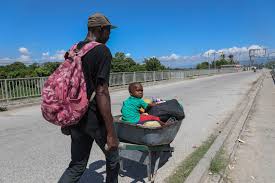
Jameson Fermilus, who had crouched in a corridor next to his house as smoke and gunfire filled the air, later joined more than 6,000 other survivors who walked for hours, seeking safety.
“We don’t know what we are going to do,” said another who joined them, 60-year-old Sonise Morino. “We have nowhere to go.”
Thousands walked west to the coastal city of Saint-Marc. Days after the massacre, a crowd of men, women and children gathered around a Good Samaritan standing atop his car distributing food and drink.
The newly homeless crowded into a church, a school and a public plaza shaded by trees. Those lucky enough to receive food sat on a dusty curb and ate. At night, they curled up on concrete floors and tried to sleep.
“These deaths are unimaginable,” Mayor Myriam Fievre said as she met with survivors.
A majority of the 6,270 people left homeless have found temporary shelter with relatives who live nearby, according to the UN’s International Organisation for Migration.
But more than 750 others have nowhere to go, joining the over 700,000 people already left homeless in recent years by gang violence across Haiti.
Inside the school serving as a temporary shelter, one mother leaned against a chalkboard, slowly patting the back of her sleeping baby as she stared into the distance.
Massacres of the Pont-Sonde magnitude were once unheard of in Haiti’s central region despite a recent increase in gang violence. Such massacres had been reported only in the capital of Port-au-Prince, 80 per cent of which is under gang control.
But things changed when former legislator Prophane Victor began arming young men nearly a decade ago to secure his election and control the area. That led to the creation of the Gran Grif gang, which controls Savien, Pont-Sonde and other places in the Artibonite region, according to the UN.
Victor and the Gran Grif leader, Luckson Elan, were sanctioned by the US last month. Elan also was sanctioned by the UN Security Council, which noted that Gran Grif “is the largest and most powerful” gang in Artibonite, committing nine mass kidnappings from October 2023 to January 2024, including that of 157 people.
During that time, Elan killed a woman for refusing to have sex with him, the UN said.
The gang, whose name means “Big Claw,” also has some of the highest levels of child recruitment in Haiti, according to the UN.
Gran Grif is one of at least 20 criminal groups that operate in Artibonite, where much of Haiti’s rice and other crops are produced. More than 22,000 people have been forced to flee in recent years as gunmen target farmers and steal crops and livestock, according to the UN, which has called authorities’ response “inadequate and inconsistent.”
In an interview Monday, Romain Le Cour, senior expert on Haiti for the Global Initiative Against Transnational Organised Crime, said he worried about the effects last week’s massacre might have on other gangs despite a new U.N.-backed mission operating in Haiti.