

Mylapore: Thirumayilai, Temple Tanks and the Cultural Nerve of Chennai

- Tamil
- Hindi
- Malayalam
- Kannada
- Telugu
Constituency No. 25 | Chennai District | General
Mylapore — or Thirumayilai — is not merely a Chennai constituency. It is one of the city’s oldest civilisational quarters, a place where sacred geography, classical culture, public life and urban politics are packed into one intensely lived landscape. Here, temple bells, church towers, sabha culture, flower markets, beach promenades and elite residential avenues all exist within a remarkably compact political space. Mylapore is old Madras, living Chennai and cultural Tamilakam in one frame.
This is a constituency of layered prestige. It carries Kapaleeswarar, Santhome, Luz, Raja Annamalaipuram, Pattinapakkam, parts of Teynampet and Nandanam, and the civic-cultural memory that goes with them. It is also a seat that must be described carefully, because neighbouring landmarks are often loosely lumped together.
In the current Assembly map, Mylapore extends across Mylapore proper, Santhome, Pattinapakkam, Raja Annamalaipuram and parts of Teynampet/Nandanam, but it does not extend into Adyar. That is an important line to hold.
Thirumayilai: More Than a Neighbourhood
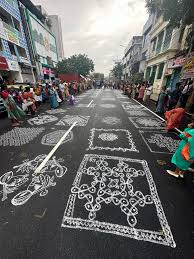
Mylapore’s importance begins with age. It is among the oldest continuously inhabited parts of Chennai and has long been remembered as a site of religion, scholarship and maritime memory. In Tamil consciousness, Thirumayilai is not an afterthought suburb. It is an origin zone — old, self-assured and culturally thick.
That is why even in today’s political map, Mylapore is not just an Assembly segment with urban wards. It is a constituency with inheritance.
Kapaleeswarar and the Sacred Core
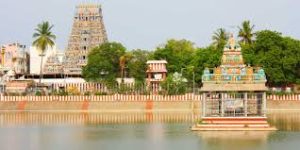
At the heart of Mylapore stands the great Kapaleeswarar Temple, one of Chennai’s defining religious landmarks and an acknowledged Paadal Petra Sthalam in the Saivite canon.
Official temple and tourism records place it squarely in Mylapore and identify it as an old Shiva shrine celebrated in Thevaram tradition. The temple’s great gopuram, Karpagambal shrine, sacred tree, festival calendar and Nayanmar associations make it not only the religious centre of Mylapore but one of the strongest cultural anchors in Chennai itself.
Around Kapali lies the older organism of Mylapore — mada streets, flower sellers, brassware shops, festival routes and the dense visual grammar of a South Indian temple-town folded into a metropolis. This is why Mylapore does not feel like a neighbourhood built around a temple. It feels like a temple-town that the city grew around.
Temple Tank and Chitrakulam Memory
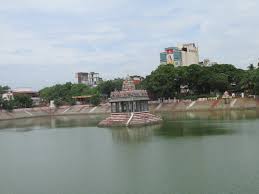
The temple tank associated with Kapaleeswarar remains one of the constituency’s defining civic-sacred spaces, especially during float festivals and seasonal ritual life. Close by lies Chitrakulam, another storied water body in the Mylapore heritage zone, tied to the older topography of tanks, shrines and settlement.
In Mylapore, tanks are not ornamental leftovers. They are memory-sites of how urban sacred space was historically organised. Even when modern traffic presses in from every side, these waterscapes keep alive the grammar of old Thirumayilai.
Thiruvalluvar, Vasuki and a Birthplace Tradition
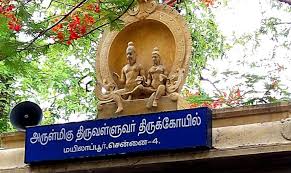
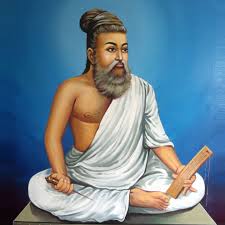
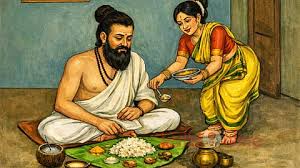 Mylapore also claims one of the most cherished literary traditions in Tamil civilisation: the association with Thiruvalluvar. The Thiruvalluvar Temple in Mylapore, under the Hindu Religious and Charitable Endowments administration, explicitly identifies the shrine as dedicated to Valluvar and located within the Ekambareswarar complex.
The long-standing local tradition holds Mylapore to be the birthplace associated with the poet-sage, and the temple honours both Valluvar and Vasuki. Whether one approaches that through faith, literary memory or cultural reverence, the association is central to Mylapore’s identity.
That matters politically too. Mylapore is not only a seat of temples and old houses. It is also a seat where Tamil ethical imagination is publicly housed.
Santhome and the Christian Layer
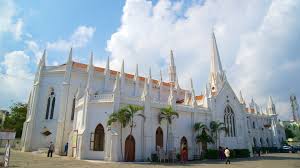
If Kapaleeswarar defines one pole of Mylapore, Santhome Basilica defines another. Tamil Nadu Tourism identifies the Santhome Cathedral and Basilica as one of Chennai’s major landmarks and locates it on Santhome High Road in Mylapore.
The church’s association with St Thomas gives the constituency a major Christian sacred landmark of international significance. Mylapore is therefore not a single-faith cultural zone. Its prestige lies partly in the coexistence of temple-town Hinduism and old Christian pilgrimage memory within the same constituency.
Luz and the Portuguese Echo
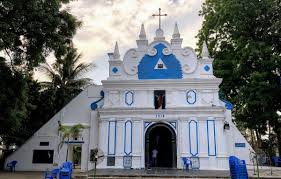
Then comes Luz Church — officially the Our Lady of Light Shrine — one of the oldest Christian sites in the city, and still one of the constituency’s most recognisable historical names.
The Archdiocese of Madras-Mylapore identifies the shrine on Luz Church Road, Mylapore. The very survival of the word “Luz” in Chennai’s urban vocabulary tells its own story: Mylapore is a constituency where Portuguese traces, Tamil sacred geography and colonial-era continuities all remain visible in everyday speech.
Beachfront, Santhome Edge and Public Life
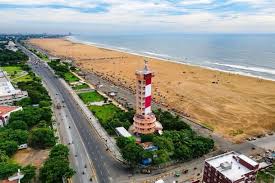
Mylapore also brushes the city’s great seafront life. The Marina–Santhome stretch, including the Gandhi statue belt and the broad public culture of the promenade, strongly influences the constituency’s civic identity.
Pattinapakkam and Santhome bring into Mylapore not just beach adjacency but fishing settlement histories, seafront public life and a distinctly Chennai rhythm of walkers, vendors, political visibility and memory. This is not all “old agraharam Mylapore”; it is a wider urban-social spread, from elite avenues to coastal everydayness.
R.A. Puram, Boat Club Edge, Teynampet Reach
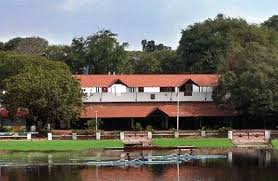
The current constituency is also politically interesting because it includes more than what many imagine when they say “Mylapore.” The polling-station and electoral rolls clearly show Raja Annamalaipuram, parts of Boat Club Road/Salai, Teynampet, Nandanam, Santhome, Pattinapakkam and Mylapore proper within the Assembly segment.
This makes the seat socially layered: temple streets, fishing quarters, middle-class flats, slum-board clusters and some of Chennai’s most affluent urban addresses all sit under one electoral umbrella.
That is why Mylapore is politically vital. It is not merely a “heritage seat.” It is a seat of contrasts.
Art, Scholarship and the Mylapore Mind
Mylapore’s reputation as a centre of art, scholarship and public culture is not accidental. The area’s temples, schools, mutts, sabhas and literary associations have long made it one of Chennai’s intellectual-cultural nerve centres.
Even when one avoids exaggeration, one fact is obvious: Mylapore has a civic temperament unlike most constituencies. It is unusually conscious of tradition, visibility, heritage and public voice. Cultural capital matters here. Symbolism matters here. So does street-level upkeep. That is why the constituency has always been watched with seriousness out of proportion to its size.
Electoral Ledger:
Mylapore’s recent elections reflect that sharp urban character.
2011
Winner: R. Nataraj (AIADMK) — 85,268 votes
Second: J. Anbazhagan (DMK) — 73,213 votes
Third: R. Rajendran (DMDK) — 21,764 votes
Margin: 12,055 votes
2016
Winner: R. Nataraj IPS (RTD)(AIADMK) — 68176 votes
Second: Karate Thiagarajan R (INC) — 53448 votes
Third: Nagarajan K (BJK) — 11720 votes
Margin: 14728 votes
2021
Winner: Dha. Velu (DMK) — 68,392 votes
Second: R. Nataraj (AIADMK) — 55,759 votes
Third: Sripriya (MNM) — 14,904 votes
Margin: 12,633 votes
What Decides Mylapore
Three things decide this constituency.
First, cultural legitimacy. Mylapore notices how a leader speaks about heritage, faith, language and civic care.
Second, urban delivery. Roads, traffic, water, drainage, park upkeep, beach-zone management and neighbourhood maintenance all matter intensely.
Third, coalition of contrasts. A candidate here must speak to temple Mylapore, coastal Santhome, affluent R.A. Puram and mixed urban settlements in the same breath.
This is not a constituency that can be read lazily.
Closing Frame
Mylapore is where Chennai remembers itself. Kapaleeswarar’s tower rises over mada streets. Chitrakulam and temple tanks keep the memory of water and worship alive. Luz preserves the Portuguese echo. Santhome keeps the apostolic strand. Valluvar and Vasuki remain part of the town’s literary-sacred imagination. The Marina edge brings public life and coastal air. R.A. Puram and Teynampet bring modern urban complexity.
So yes — Mylapore is a city seat. But it is also much more than that. It is a constituency of civilisation, contradiction, refinement and noise; of prayer and parking; of jasmine and jurisprudence; of scholarship and street politics.
When Mylapore votes, Chennai pays attention.