


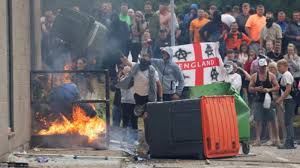
 London, August 10: The United Kingdom is witnessing widespread street riots as anti-immigration protests spiral out of control in major towns and cities. The violence, sparked by a brutal stabbing incident in Stockport, has led to mass unrest, with hundreds arrested and extensive damage reported. Prime Minister Keir Starmer’s newly-formed government is facing severe criticism for its handling of the crisis, with many accusing it of being slow to respond to the escalating tensions.
The unrest began over a week ago when three young girls were fatally stabbed during a dance event in Stockport. The suspect, a 17-year-old boy, was initially kept anonymous under British law but was later identified as Axel Muganwa Rudakubana, a Cardiff-born youth of Rwandan descent. Despite no connection to Islam or immigration, social media was flooded with false claims that Rudakubana was a Muslim asylum seeker, sparking outrage among far-right groups.
The misinformation quickly spread, igniting violent protests across economically distressed northern towns and cities. Protesters, driven by anti-Muslim sentiment, targeted mosques, businesses, and hotels housing asylum seekers. The police have linked the coordination of these attacks to far-right extremist groups using platforms like WhatsApp and Telegram. Prime Minister Starmer condemned the riots as “far-right thuggery,” but the violence continues unabated.
Central to the unrest has been the involvement of notorious far-right figure Tommy Robinson. Robinson’s inflammatory online posts, which include references to “British girls being hunted” and “our women being treated as halal meat,” have been shared widely, fueling the protests. Although Robinson later urged his followers to remain calm, the damage was already done, with his earlier rhetoric contributing to the outbreak of violence.
Underlying the immediate spark of the Stockport stabbings are deeper tensions surrounding immigration in the UK. Protesters have voiced grievances over what they see as unchecked immigration overwhelming public services and contributing to unemployment. The perception that asylum seekers are receiving preferential treatment, such as being housed in four-star hotels, has only added to the anger in economically struggling communities.
Adding fuel to the fire, tech mogul Elon Musk waded into the controversy by suggesting that a civil war in Britain might be imminent. His comments were met with condemnation from the Labour government, which accused him of irresponsibly inciting further unrest. Musk’s remarks have echoed those of far-right voices in both the UK and the US, heightening fears that Britain is on the brink of deeper societal division.
As the riots continue to spread, the Starmer government faces growing pressure to restore order and address the underlying issues. Critics argue that the government’s response has been slow and inadequate, pointing to the absence of community engagement initiatives that have successfully de-escalated tensions in the past. The ongoing violence marks a critical test for Starmer’s leadership, with the nation’s stability hanging in the balance.