


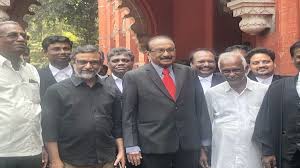
The Madras High Court has dismissed a writ petition filed by MDMK general secretary Vaiko challenging the Centre’s decision to ban the Liberation Tigers of Tamil Eelam (LTTE), holding that a third party cannot question the prohibition when the organisation itself has not mounted a challenge.
Vaiko had moved the High Court in 2013 assailing a 2012 notification issued by the Union government extending the ban on the LTTE. He contended that there was no substantive material to establish that the outfit had engaged in activities threatening India’s sovereignty and integrity.
However, a Division Bench comprising Justices Anita Sumanth and Mummineni Sudheer Kumar observed that the 2012 notification under challenge was no longer in force. The present prohibition, the court noted, stems from a 2024 notification, rendering the earlier plea infructuous. On this ground, the Bench dismissed the writ petition.
Court Questions Maintainability
During the hearing, the Union government argued that Vaiko had no locus standi to maintain the petition. Additional Solicitor General A.R.L. Sundaresan submitted that the Tribunal constituted to review the validity of the ban had already rejected Vaiko’s application seeking to implead himself in the proceedings. The Tribunal had upheld the continuation of the ban.
In light of that dismissal, the Centre contended that Vaiko was not entitled to independently challenge the notification before the High Court.
The Bench accepted the argument that the specific 2012 notification was no longer operative and therefore did not warrant adjudication at this stage.
Vaiko, leader of the Marumalarchi Dravida Munnetra Kazhagam, maintained that he had approached the court as a supporter and sympathiser of the LTTE, questioning the legality of the ban. He argued that there was no evidence to substantiate claims that the organisation sought to merge Tamil Eelam with India or acted against the country’s sovereignty.
According to him, in the absence of such material, the continued prohibition was unlawful and liable to be set
The LTTE was first banned in 1992 following the assassination of former Prime Minister Rajiv Gandhi in May 1991. Since then, the prohibition has been periodically extended through fresh notifications issued by the Centre.
Initially renewed every two years, the ban was later extended for five-year periods. The most recent extension was issued in 2024, replacing earlier notifications, including the 2012 order that Vaiko had challenged.
With the High Court’s dismissal of the petition, the ban on the LTTE continues to remain in force under the current notification framework.