


Washington July 10:
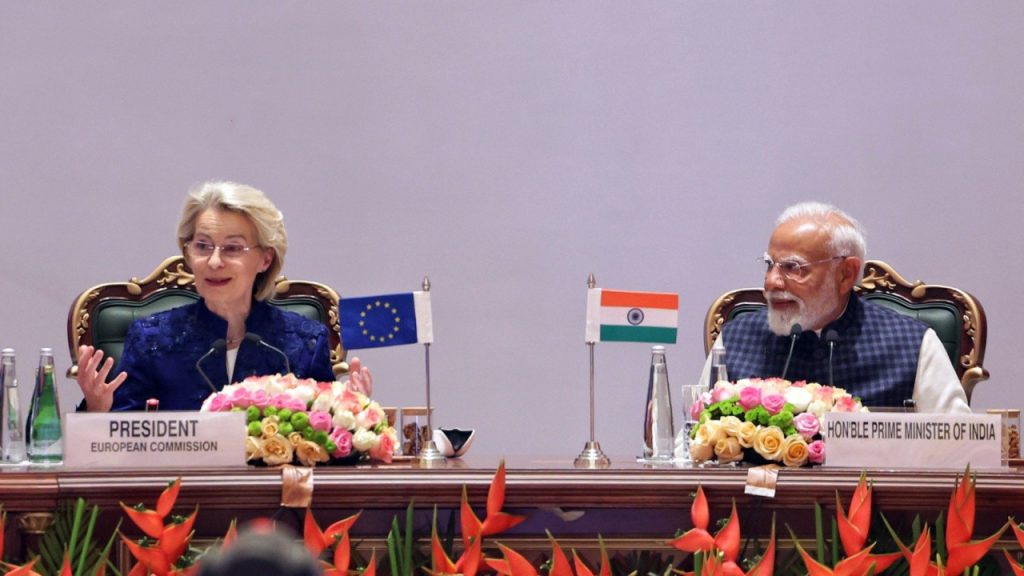
The European Union has rejected suggestions that shifting US trade policies under President Donald Trump drove the conclusion of its landmark free trade agreement with India, saying the pact was the result of years of political commitment and a shared strategic vision rather than short-term geopolitical developments.
The remarks came after Christophe Kiener, the European Union’s chief negotiator for the agreement, on Wednesday (local time) pushed back against a suggestion during a discussion hosted by the Peterson Institute for International Economics that recent trade turbulence may have accelerated the negotiations.
“I would dispute that,” Kiener said. “We did not conclude this agreement because of a tweet. We concluded this agreement because there is a genuine and strategic and economic interest for the EU and India to come closer.”
Kiener said that the international trading environment had become increasingly uncertain in recent years but maintained the foundations of the pact were laid well before the current wave of trade tensions.
He said the European Union and India had built a broader partnership encompassing trade, security, defence, mobility and technology, describing the free trade agreement as “the jewel on the crown” of that relationship. The agreement, he added, is “commercially very, very meaningful” and forms part of a long-term effort to strengthen economic ties between two major democracies.
He recalled that the original negotiations stalled because “the EU’s menu for FTA did not quite match that of India,” leading both sides to suspend talks in 2013. When negotiations restarted in 2022, they began afresh rather than relying on earlier draft texts.
According to Kiener, several developments reinforced the need for closer cooperation, including the failure to advance global trade liberalisation through the World Trade Organization, lessons from the Covid-19 pandemic about supply-chain resilience and the instability created by Russia’s war against Ukraine.
He said those developments encouraged both sides to strengthen economic ties based on predictable rules and diversified supply chains.