


Kathmandu, Sept 1:
Nepal’s search and rescue operations following the devastating flash floods have been hampered by severe shortages of specialised equipment, body bags, ropes and helicopters as authorities struggle to locate thousands of missing people.
The death toll crossed 900 on Monday, while more than 4,000 people remained missing, according to Nepal’s National Disaster Risk Reduction and Management Authority (NDRRMA).
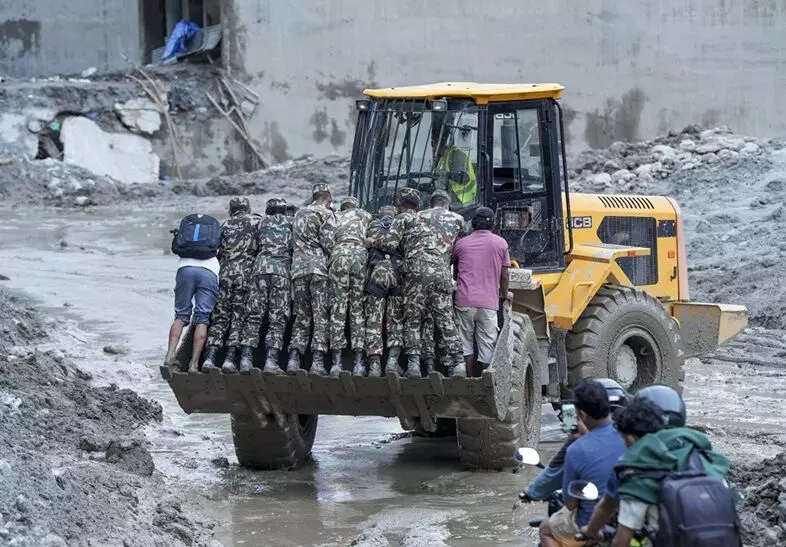
Security personnel from the Nepal Army, Nepal Police and Armed Police Force have been deployed in large numbers across the affected areas. However, officials said difficult terrain and inadequate rescue equipment were slowing the operations.
Thermal cameras, life-detection devices, specialised cutting equipment, body bags, ropes and advanced helicopters are among the items in short supply.
Security personnel have repeatedly requested helicopters to reach people trapped in remote or inaccessible locations.
Police officials said several people had contacted emergency services seeking assistance, but rescue teams were sometimes unable to reach them because of difficult terrain and inadequate equipment.
The shortage of body bags and ropes has also complicated the recovery of bodies.
Around 19,895 security personnel have been mobilised for rescue operations, including 7,293 police personnel, 8,399 Army personnel and 4,203 members of the Armed Police Force.
The Armed Police Force has deployed trained sniffer dogs to help locate victims buried beneath debris. Officials said canine teams were finding several bodies each day based on signals received from the dogs.
Specialised teams are conducting mass rescue, medical assistance, rope rescue, water rescue, diving, drone surveillance and searches at collapsed structures.
Nepal has sought specialised personnel and equipment from India and China.
India has already sent technical teams, including tunnel-rescue specialists and forensic experts, along with relief supplies. A 19-member Indian forensic team has begun DNA analysis to assist Nepal in identifying recovered remains.
Indian and Chinese teams are also assisting in searches at hydropower projects where hundreds of workers and employees have remained unaccounted for since the disaster.
The catastrophe was triggered by an enormous flow of ice, rock and debris in the Himalayan region near the Nepal-Tibet border, which swept through the Bhotekoshi-Trishuli corridor, destroying homes, roads, bridges and hydropower infrastructure.
The disaster has exposed gaps in Nepal’s disaster-management capacity, with officials also pointing to inadequate funding and a shortage of technical experts.
Rescue operations are continuing as authorities race against time to locate survivors and recover bodies in the devastated areas.Ice-rock avalanche triggered Nepal floods
Kathmandu, Aug 31: A massive ice-rock avalanche in the high Himalayas, rather than conventional rainfall, triggered the devastating flash floods that swept through Nepal’s Bhotekoshi-Trishuli corridor, according to a preliminary report by Nepalese scientists.
The report, commissioned by the Nepal Environment Society and released on Sunday, said a huge mass of ice, rock and debris fell from an elevation of around 5,200 metres in the Langtang-Lirung region of Rasuwa and entered the Lhende River.
The resulting surge travelled downstream through the Bhotekoshi and into the Trishuli, generating a powerful debris-laden flood that devastated settlements and infrastructure.
The disaster has killed hundreds of people, with the death toll reaching 903 by Monday, while thousands remained missing.
Scientists examining satellite imagery found evidence that part of a glacier had broken away from the Langtang-Lirung peak near the Tibet border.
Clearer imagery subsequently showed that the bedrock beneath the glacier had collapsed, carrying a massive volume of ice and rock into the valley.
The enormous flow changed the colour of the rivers as huge quantities of sediment and mud were carried downstream.
Towns and villages along the riverbanks were buried under mud and debris. Several buildings were completely destroyed, while others were left partially submerged.
The tourist settlement of Syapru Besi was among the areas badly affected. The flood also widened river channels and swept away roads, bridges and other infrastructure.
Earth scientists said the scale of the event was extraordinary.
Researchers have also examined whether climate change contributed to the instability of the mountain environment.
Mountain geographer Alton Byers said warming temperatures are melting glaciers and permafrost, potentially weakening the rock, soil and ice that hold high-altitude slopes together.
However, scientists Kristen Cook and Dan Shugar cautioned that a direct link between climate change and this specific collapse could not yet be established.
They noted that landslides and slope failures can occur naturally, although warming conditions and melting permafrost could make such events more likely.
The findings have added urgency to calls for better monitoring of glaciers, high-altitude lakes, unstable slopes and other potential hazards in the Himalayan region.
With rescue teams still searching for thousands of missing people, scientists say the disaster demonstrates the need for stronger early-warning systems and improved monitoring of rapidly changing mountain environments.