

2016: Policy Promises and Welfare Politics

🌐 Translate ▾
- Tamil
- Hindi
- Malayalam
- Kannada
- Telugu
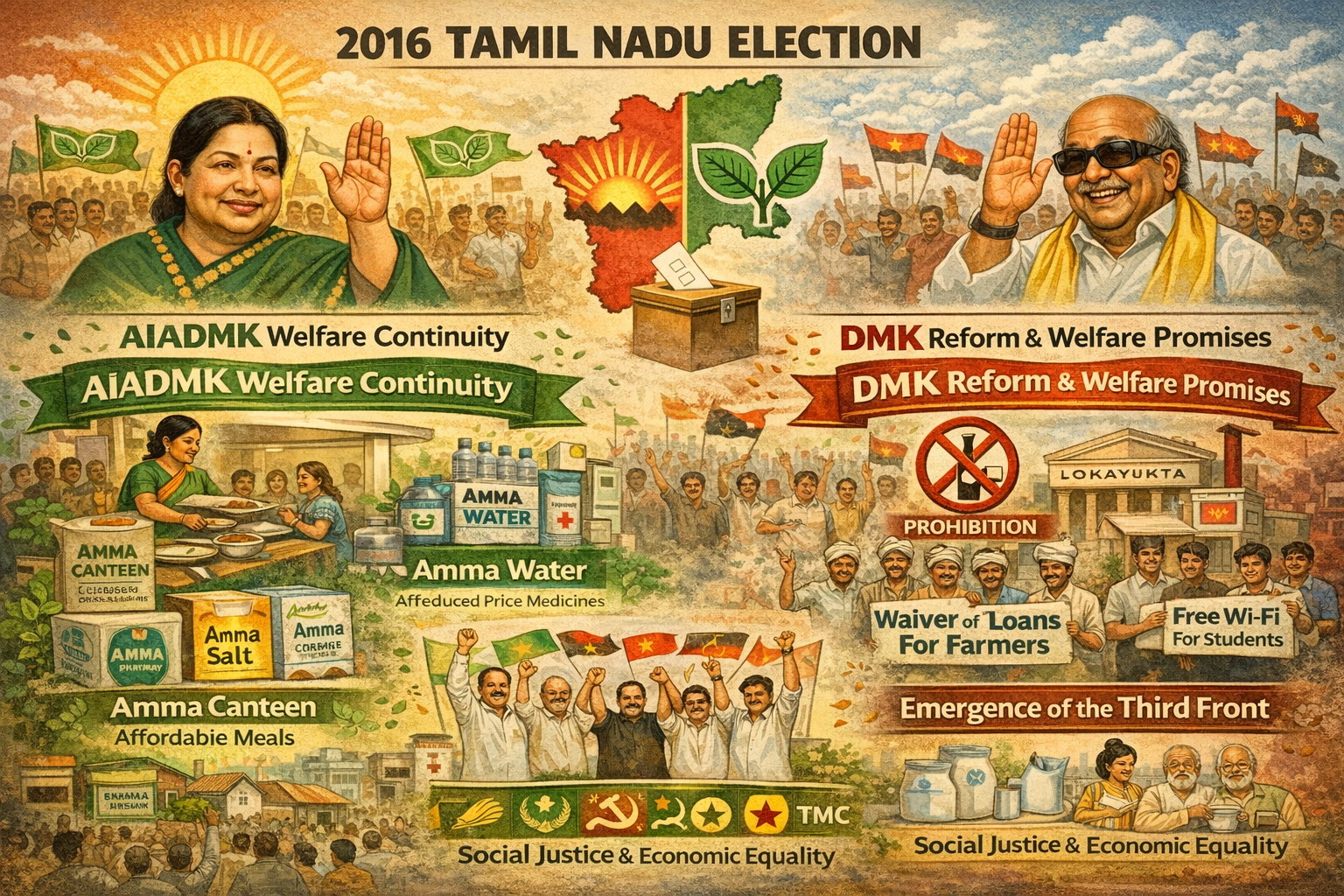
The 2016 Tamil Nadu Legislative Assembly election was one of the most competitive and politically significant elections in the recent history of Tamil Nadu. The primary contest was between the ruling All India Anna Dravida Munnetra Kazhagam (AIADMK) led by J. Jayalalithaa and the opposition Dravida Munnetra Kazhagam (DMK)headed by M. Karunanidhi.
Unlike earlier elections where anti-incumbency often led to a change in government, the 2016 election was notable because the ruling party managed to retain power. The campaign was shaped by policy promises, welfare programs, leadership appeal, and emerging third-front alliances, making it a complex multi-cornered political contest.
Political Context Before the Election
The AIADMK government led by Jayalalithaa had returned to office in 2011 and implemented several welfare schemes during its tenure. Programs branded under the “Amma” welfare model—including subsidised food, medicines, and drinking water—became widely popular among urban and low-income populations.
At the same time, the political environment leading into the election was influenced by several challenges. These included flood management issues following the devastating 2015 Chennai floods, concerns about urban infrastructure, and debates over the expansion of liquor retail outlets run by the Tamil Nadu State Marketing Corporation (TASMAC).
Public debates over prohibition, governance transparency, and welfare expansion therefore became key themes of the campaign.
The DMK Manifesto: Governance Reforms & Social Welfare
The DMK manifesto in 2016 focused strongly on governance reforms, anti-corruption mechanisms, and economic support policies aimed at addressing the concerns of various sections of society.
One of the most prominent promises was the introduction of total prohibition in Tamil Nadu. The party proposed gradually shutting down liquor outlets operated by TASMAC, responding to growing public demands—especially from women’s groups and social activists—who argued that alcohol consumption was causing significant social and economic harm to families.
Another major proposal was the establishment of a Lokayukta institution to investigate corruption allegations involving public officials. By promising such a mechanism, the DMK sought to highlight transparency and accountability in governance.
The manifesto also included several welfare initiatives designed to appeal to key voter groups:
Waiver of crop loans for farmers
Educational loan waivers for students
Free Wi-Fi facilities for students in educational institutions
Expansion of financial assistance for women’s marriage schemes
In addition, the DMK promised to reduce the price of Aavin milk, which was a widely consumed product across the state, and to expand social welfare programs for low-income households.
Water management and environmental sustainability were also emphasized. The party proposed large-scale investments in desalination plants, restoration of lakes, and improved management of water bodies, aiming to address the state’s recurring water shortages and drought conditions.
Through these promises, the DMK attempted to present itself as a party focused on institutional reform, social welfare, and long-term infrastructure planning.
The AIADMK Manifesto: Continuity of Welfare Programs
The AIADMK manifesto in 2016 emphasised continuity and expansion of the welfare initiatives introduced during Jayalalithaa’s previous tenure. The party highlighted the success of the “Amma brand” schemes, which had become a defining feature of its governance model.
Among the most well-known initiatives were:
Amma Canteens, which provided subsidised meals to urban residents
Amma Pharmacies, offering medicines at reduced prices
Amma Drinking Water, supplying affordable packaged water
Amma Salt and Amma Cement, designed to reduce the cost of essential commodities
These programs were particularly popular among working-class populations in urban areas and among economically weaker sections.
The AIADMK manifesto also promised further expansion of welfare schemes for:
Women, including social support programs and financial assistance
Farmers, through subsidies and irrigation improvements
Students, via educational assistance and scholarship programs
In addition to welfare policies, the AIADMK pledged to continue infrastructure development, urban modernisation, and improvements in law enforcement. The party framed its campaign around the theme of stable governance and proven leadership under Jayalalithaa.
Emergence of the Third Front: Makkal Nala Kootani
The 2016 election was also notable for the emergence of a third political alliance known as the Makkal Nala Kootani(People’s Welfare Alliance). This coalition attempted to position itself as an alternative to the two dominant Dravidian parties.
The alliance initially included parties such as:
Marumalarchi Dravida Munnetra Kazhagam
Communist Party of India (Marxist)
Communist Party of India
Viduthalai Chiruthaigal Katchi
Later, it was joined by the Desiya Murpokku Dravida Kazhagam (DMDK) and the Tamil Maanila Congress (Moopanar), making the alliance a significant third force in the electoral arena.
The alliance’s manifesto emphasised social justice, economic equality, and welfare support for marginalised communities.
Welfare and Social Security Proposals
One of the key promises made by the Makkal Nala Kootani was increasing the old-age pension to ₹3,000 per month, a substantial increase from the existing pension levels.
The alliance also proposed increasing financial assistance under the Green Housing Scheme to ₹4 lakh per house, aimed at improving housing conditions for economically weaker sections.
Another notable proposal was the distribution of half a litre of free milk daily to families with infants and school-going children. This initiative was designed to address child nutrition and health outcomes, particularly among low-income households.
Economic & Social Policy Agenda
The alliance emphasised the need to strengthen agriculture and rural livelihoods, promising policies to ensure fair prices for agricultural produce and improved institutional support for farmers.
Employment generation was another major priority. The manifesto proposed initiatives to create job opportunities for young people and reduce economic inequality.
Education and healthcare reforms also featured prominently. The alliance proposed:
Strengthening government schools
Improving public healthcare infrastructure
Ensuring better access to higher education for students from disadvantaged backgrounds
Through these proposals, the coalition attempted to appeal to voters seeking an alternative to the long-standing DMK–AIADMK political dominance.
Election Results & Political Significance
When the results of the 2016 Tamil Nadu Assembly election were declared, the AIADMK led by Jayalalithaa secured victory and returned to power.
This outcome was historically significant because it marked the first time in more than three decades that a ruling party in Tamil Nadu was re-elected consecutively. Since the late 1980s, power had typically alternated between the DMK and AIADMK due to strong anti-incumbency trends.
Jayalalithaa’s victory demonstrated the continuing electoral appeal of welfare schemes, charismatic leadership, and targeted social programs.
Legacy of the 2016 Election
The 2016 election reinforced the importance of policy-driven manifestos and welfare politics in Tamil Nadu’s electoral system. It showed that voters evaluated parties not only on ideological lines but also on practical benefits delivered through welfare schemes and development initiatives.
The election also demonstrated the difficulty faced by third-front alliances in breaking the dominance of the two major Dravidian parties, despite presenting comprehensive policy proposals.
Overall, the 2016 election became another milestone in the evolution of Tamil Nadu’s political culture, where leadership, welfare governance, and manifesto promises continue to shape electoral outcomes.