


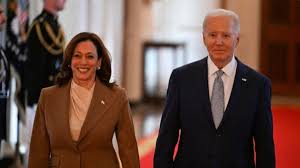
 Washington, July 20: Less than four months before the upcoming election, Vice-President Kamala Harris finds herself in a critical position. President Joe Biden’s recent debate performance has led to increasing doubts about his ability to win the election. Amid growing anxiety within the Democratic Party, Kamala Harris has emerged as a possible replacement candidate.
Four years ago, Harris, then a candidate for the Democratic nomination, would have welcomed the party’s praises. Now, as part of an embattled incumbent ticket, she must navigate a delicate situation. How strongly should she support her running mate, knowing her own political future hangs in the balance? In the 24 hours following the debate debacle, Harris chose loyalty, defending Biden on CNN, MSNBC, and at a campaign rally.
Despite speculation about Biden’s chances, Harris has not wavered in her support. High-ranking Democrats have expressed varying levels of support for Biden, leading to a party-wide reckoning. Meanwhile, Harris’ support has grown stronger, with Republicans incorporating her name into Trump’s campaign messaging.
Kamala Harris made history as the first woman, first black, and first Asian American vice president. Despite low approval ratings, her supporters highlight her advocacy for reproductive rights, appeal among black voters, and background as a prosecutor. Nadia Brown, director of Georgetown University’s Women’s and Gender Studies Program, praised Harris’ instrumental role in addressing key issues like voting rights and immigration reform.
Five years ago, Harris was a California senator aiming for the Democratic presidential nomination. Her career began in the Alameda County District Attorney’s Office, followed by her election as San Francisco’s district attorney in 2003. In 2010, she became California’s first female and first black attorney general. Harris’ reputation as a rising star propelled her to the Senate in 2017, but her 2020 presidential campaign faltered.
Despite her unsuccessful presidential bid, Biden chose Harris as his running mate, a move Gil Duran, her former communications director, described as a “big reversal of fortune.” Harris’ role in the Biden administration included launching a nationwide “Fight for Reproductive Freedoms” tour and casting tie-breaking votes in the Senate to pass significant legislation.
Born in Oakland, California, to an Indian mother and Jamaican father, Harris was primarily raised by her Hindu single mother. Her biracial heritage and upbringing allowed her to engage with multiple American identities. Her time at Howard University, a historically black college, was among the most formative experiences of her life.
Harris is comfortable in both predominantly black and white communities. She spent part of her childhood in Canada, attending school in Montreal. Harris has always embraced her identity, describing herself simply as an “American.”
From her early years, Harris displayed the skills that helped her break barriers. Her wit and humor were evident during university debates, and these traits have continued to be part of her political arsenal. Her ability to deliver zingers in live debates fueled her initial bid for the Democratic nomination.
In 2014, Harris married lawyer Doug Emhoff, becoming stepmother to his two children. She is often portrayed as the epitome of a modern American blended family. Harris is also seen as the descendant of generations of black female activists, inheriting a legacy of grassroots organizers and elected officials.
As speculation about Biden’s ability to win in November grows, Harris has found renewed support. Her unique background, combined with her political accomplishments, positions her as a potential future leader of the Democratic Party.