


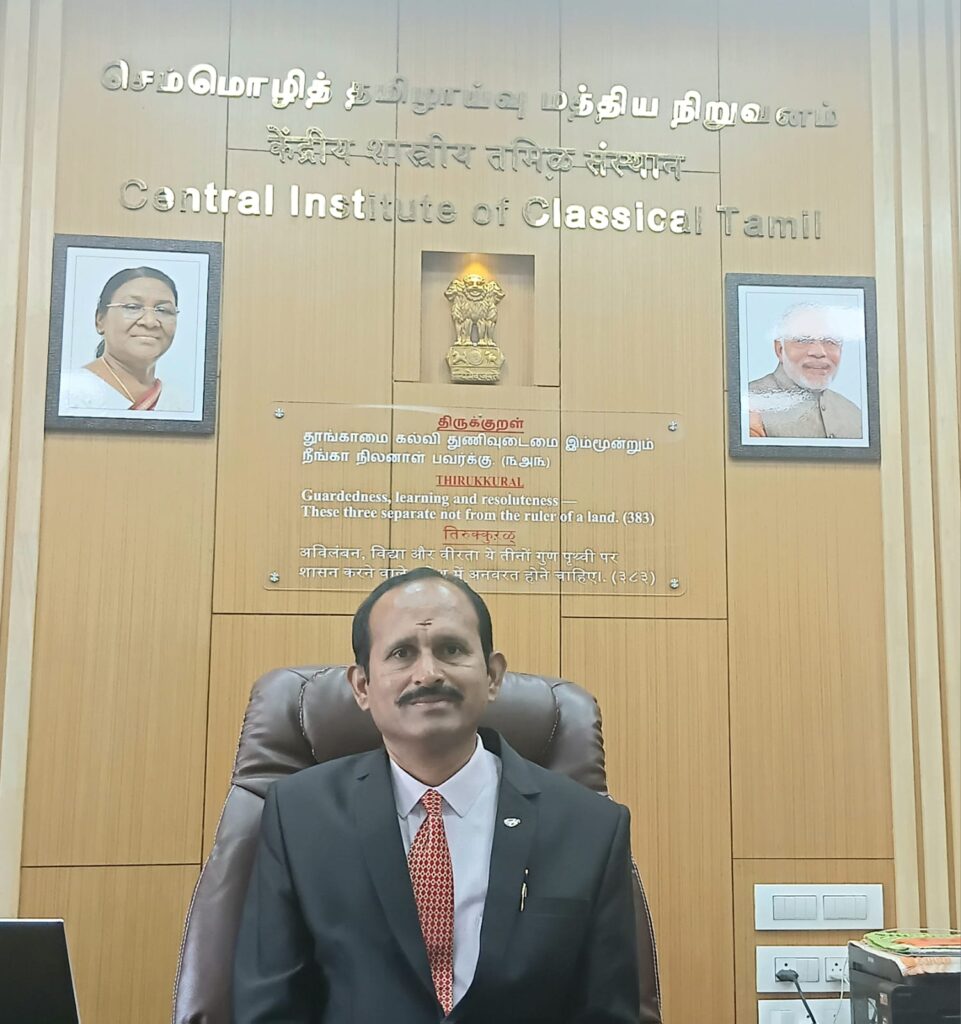
The Central Institute of Classical Tamil (CICT), an autonomous body under the Union government, has become a powerhouse of scholarship and preservation, breathing new life into the treasures of Tamil’s classical era. From deciphering ancient grammar texts to archiving rare manuscripts and translating Sangam classics for a global audience, CICT is on a mission to showcase Tamil’s timeless grandeur.
In an exclusive conversation with News Today, CICT Director Chandrasekaran shares insights into the institute’s vision, achievements, and innovations — while crediting Prime Minister Narendra Modi for his ‘deep, unwavering admiration’ for Tamil and his push to make Thirukkural resonate in over 100 languages worldwide.
Q: Prime Minister Modi’s love for Tamil is well known. How has it influenced CICT’s goals?
A: The Prime Minister is a true connoisseur of Tamil. His admiration for Thirukkural is no secret, and he has given us a clear mission: to make this ancient treasure accessible to the world by translating it into at least 100 languages. We’ve already completed translations in 35 languages. This is not just a project — it’s a cultural movement to ensure Thirukkural’s wisdom echoes in every corner of the globe.
Q: What is CICT’s primary role in Tamil scholarship?
A: We focus solely on Tamil’s classical era — from its earliest roots up to 600 A.D. Our mission is to highlight Tamil’s uniqueness and antiquity through masterpieces like Tolkāppiyam, the oldest extant grammar text, and the Eight Anthologies of Sangam poetry. These works are not mere translations or derivatives; they are pure voices from an ancient world, reflecting the culture, language, and ethos of the Tamils.
Q: What are the key pillars of your work?
A: Research: Delving deep into Tamil’s antiquity and cultural heritage.
Preservation: Safeguarding ancient manuscripts, inscriptions, and records.
Translation: Publishing authoritative editions and translating classics into Indian and foreign tongues.
Education: Offering fellowships, digital libraries, and online courses. We also organise seminars and global conferences to foster vibrant academic dialogue.
Q: Tamil has always been global. How does CICT connect with the diaspora today?
A: Tamil’s global reach isn’t new — our ancient literature records trade ties with Greece and Rome, and excavations at Arikamedu and Keezhadi prove this. We’ve signed MoUs with international institutions to access Tamil manuscripts preserved abroad. We’re translating them widely so that Tamil’s literary wealth is no longer confined by geography.
Q: Technology is changing everything. How has CICT embraced it?
A: Technology is our bridge to the world. We have a vibrant online presence through YouTube, Instagram, Facebook, LinkedIn, and X, and we’ve launched a dedicated app that houses our entire library. AI is playing a pivotal role in speeding up translations and connecting us to a vast audience.
But inclusivity is our proudest innovation. Soon, Thirukkural will be available in sign language, and videos are ready. We’ve already released Braille editions for the visually challenged. These efforts ensure nobody is excluded from Tamil’s legacy.
Q: What is your message to students pursuing Tamil?
A: The future is bright for those who embrace Tamil with passion. Career opportunities abound, but students must first fall in love with the language. I remember my professors inspiring a deep respect for Tamil in my college days. Today’s students must use institutions like CICT, dive into our classical texts, and reduce their reliance on other languages when reading or writing Tamil. Mastery comes from passion — and passion from immersion.