


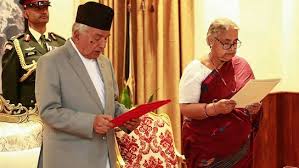
 Kathmandu, Oct 15: Nearly a dozen writ petitions were filed at Nepal’s Supreme Court on Tuesday, challenging the recent appointment of former Chief Justice Sushila Karki as Prime Minister and the dissolution of the House of Representatives.
President Ram Chandra Poudel had appointed Karki on September 12 under Article 61 of the Constitution, which pertains to the President’s responsibilities during crises, rather than Article 76, which outlines the process for electing a Prime Minister. On her recommendation, the Lower House was dissolved, and fresh elections were scheduled for March 5, 2026.
Ten writs questioned the constitutionality of both the appointment and the dissolution. One petition, filed by lawyer Yubaraj Poudel, argued that the Constitution prohibits former Chief Justices from holding government positions, citing Article 132(2).
Petitioners also called for the reinstatement of the House to enable possible impeachment proceedings against the President for constitutional violations.
Legal experts have criticized the appointment as based on the “doctrine of necessity” — a practice used during political crises in Nepal’s history — rather than the rule of law.
Constitutional lawyer Bipin Adhikari warned that relying on such a principle undermines the Constitution and may lead to habitual violations.
The move has intensified political tensions, with the CPN-UML, led by former Prime Minister KP Sharma Oli, demanding reinstatement of the dissolved House. This echoes a similar 2013 case when Chief Justice Khil Raj Regmi was controversially appointed as head of government; the Supreme Court delayed hearing that case for years.
Meanwhile, Nepali Congress President Sher Bahadur Deuba appeared publicly, recalling violent attacks during recent Gen-Z protests and announcing he would not run for party president again.
Protesters have demanded the exit of senior political leaders, including Deuba, Oli, and Prachanda, signaling growing public frustration with the political establishment.