


 Tehran, Jan 12: Iran’s parliament speaker, Mohammad Bagher Qalibaf, warned on Sunday that US military forces and Israel would be “legitimate targets” if the United States strikes Iran in response to nationwide protests that have shaken the country for more than two weeks.
His remarks came after US President Donald Trump threatened possible military action and voiced support for Iranian protesters.
The protests, which began on December 28 over the collapse of Iran’s currency and broader economic hardship, have grown into a direct challenge to the country’s theocratic leadership. Demonstrations continued into Sunday in Tehran and Mashhad, Iran’s second-largest city.
According to the US-based Human Rights Activists News Agency (HRANA), at least 203 people have been killed, including 162 protesters and 41 members of the security forces, with fears the true toll is significantly higher.
More than 3,280 people have been arrested, the group said. Iranian authorities have not released official casualty figures, and independent verification has been hampered by widespread internet and phone shutdowns.
Speaking in a televised parliamentary session, Qalibaf praised police, the Revolutionary Guard and the Basij militia for “standing firm” against demonstrators. He warned that any US attack would prompt Iran to target American military bases, ships and assets across the region, as well as Israel, which he referred to as “the occupied territory.”
Lawmakers echoed his stance by chanting “Death to America.” While the seriousness of Iran’s threats remains unclear—particularly after damage to its air defenses during a brief war with Israel earlier this year—any decision to escalate militarily would ultimately rest with Supreme Leader Ayatollah Ali Khamenei.
The US military said it remains fully prepared to defend its forces and interests in the Middle East, where American troops are stationed in countries including Qatar and Bahrain. Israel said it is closely monitoring developments, while Prime Minister Benjamin Netanyahu held talks with US Secretary of State Marco Rubio.
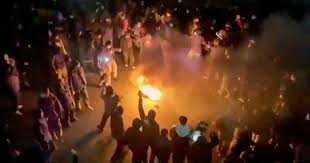
Inside Iran, videos circulating online—some reportedly transmitted via satellite internet—show protesters gathering in Tehran neighborhoods, waving phone lights, banging metal objects and blocking streets.
In Mashhad and Kerman, footage appeared to show clashes with security forces. State television countered by broadcasting images of calm streets and pro-government demonstrations elsewhere.
Iranian officials hardened their rhetoric, with senior figures accusing protesters of violence and extremism. Even reformist President Masoud Pezeshkian struck a tougher tone, saying authorities should listen to public grievances but would not tolerate “rioters” threatening social order.
Exiled Crown Prince Reza Pahlavi called for further protests, as activists warned that the ongoing communications blackout could enable a harsher crackdown in the days ahead.