


United Nations, June 10:
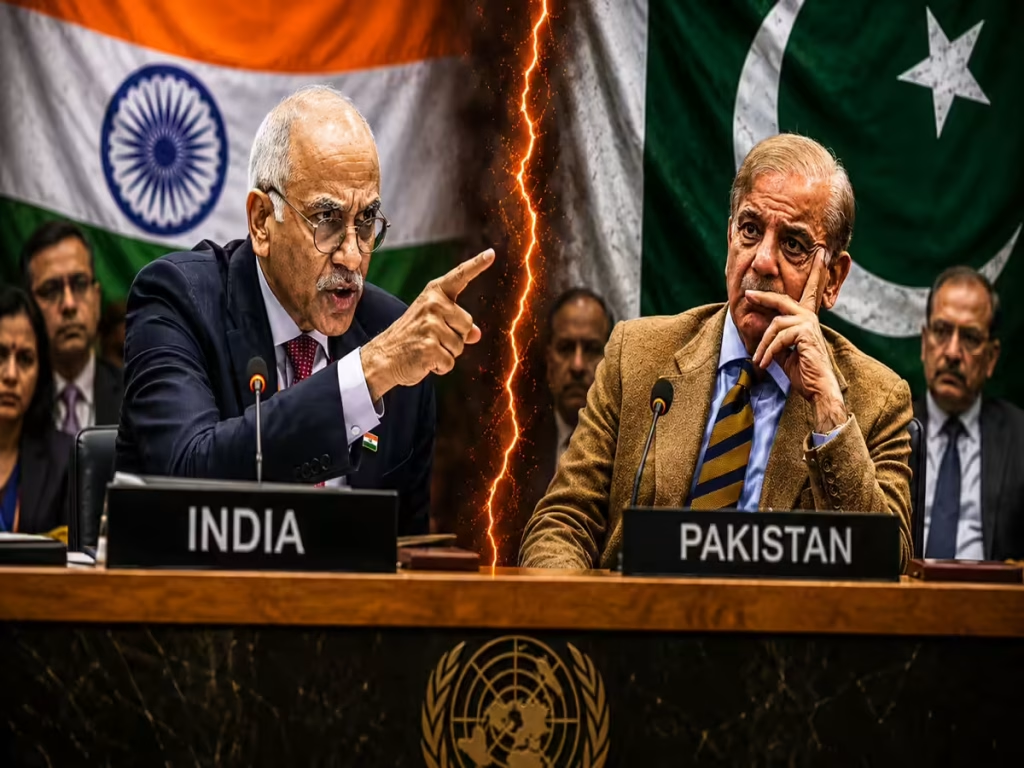
India launched a sharp attack on Pakistan at the United Nations Security Council, accusing it of violating Afghanistan’s sovereignty through military airstrikes and inflicting what it described as “trade and transit terrorism” on the Afghan people.
Speaking at a UN meeting on Afghanistan, India’s Permanent Representative to the UN, Harish Parvathaneni, strongly condemned Pakistan’s airstrikes on Afghan territory, calling them flagrant violations of international law, the UN Charter and the principle of state sovereignty.
Citing data from the UN Assistance Mission in Afghanistan (UNAMA), Parvathaneni noted that 372 civilians were killed and 397 injured in the first three months of the year, many during the holy month of Ramadan.
He said no faith, law or moral principle could justify such violence and accused Pakistan of attempting to disguise civilian casualties as counterterrorism operations.
“Dressing up a massacre as a military operation does not absolve the perpetrator,” he said, adding that killing and maiming civilians could not be considered counterterrorism.
India also criticised Pakistan’s decision to label Balochistan-based militant groups as “Fitna al Hindustan,” calling it state-sponsored misinformation designed to foster hostility toward India.
Parvathaneni described the move as part of an “organised factory of hate” driven by Pakistan’s deep state to divert attention from domestic political and economic challenges.
He also referred to Pakistan’s 27th Constitutional Amendment, arguing that it reflected increasing military influence in the country.
On the economic front, India accused Pakistan of weaponising Afghanistan’s dependence on transit routes by restricting trade access for Afghan goods.
Describing this as “trade and transit terrorism,” India argued that Pakistan’s actions violate World Trade Organisation norms, UN declarations concerning landlocked developing countries and broader principles of international law.
India highlighted its own efforts to support Afghanistan through tariff-free market access, a dedicated air freight corridor and long-term business visas for Afghan traders.
Responding to Pakistan’s criticism of UNAMA reports, India defended multilateral institutions and stressed that support for the UN cannot be selective.
Parvathaneni also reiterated India’s commitment to combating terrorism, calling for coordinated international action against groups such as ISIL, Al-Qaeda, Lashkar-e-Taiba, Jaish-e-Mohammed and their affiliates, including The Resistance Front.