


Chennai, Aug 19:
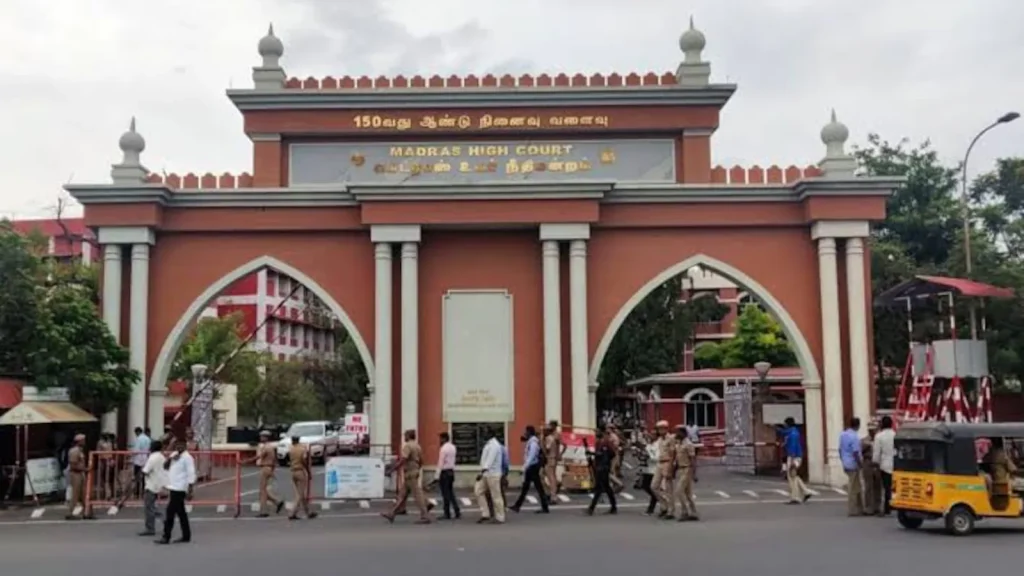
The Madras High Court on Tuesday evening observed that there is no bar on singing the Tamil Thai Vazhthu (invocation song to Mother Tamil) first at government functions in Tamil Nadu, under the Centre’s latest notification.
The court said there was no order mandating the state song to be recited last and that it could sung first in all government events.
A public interest litigation was filed by Chennai resident Ananya Radhakrishnan, seeking directions to authorities to ensure that government functions in Tamil Nadu begin with the Tamil Thai Vazhthu.
The petitioner contended that government functions in Tamil Nadu have traditionally begun with the Tamil Thai Vazhthu and concluded with the National Anthem. She alleged that a January 28 circular issued by the Union Home Ministry had diluted this practice by requiring Vande Mataram to be sung first and relegating the State song to the third place after Nationao Anthem.
During the hearing before Chief Justice Sushrut Arvind Dharmadhikari and Justice G. Arul Murugan, the Centre clarified that its fresh notification issued on July 9 only requires Vande Mataram and the National Anthem to be sung one after another, with Vande Mataram preceding the National Anthem.
The Centre also pointed out that the notification does not mention the State Song or require it to be sung at the end.
The judges observed that the latest notification does not prevent the Tamil Thai Vazhthu from being sung first, followed by Vande Mataram and the National Anthem.
The Bench noted that this was the sequence followed at the Madras High Court on Independence Day—Tamil Thai Vazhthu first, followed by Vande Mataram and the National Anthem.
After making these observations, the court reserved its verdict in the case.
It may be recalled that on a day when the Tamil Nadu Assembly adopted a resolution mandating singing of Tamil thai Vazhthu (invocation to Mother Tamil) first in all government and public functions, the union Government had on August 10m informed the Court that it has not issued any order that the State song should be recited last.
Appearing for the Centre, Additional Solicitor General A.R.L. Sundaresan informed the First Bench that the union Home Ministry had only stated that Vande Mataram and National Anthem should be recited at all events and has not issued any directive on the order of the recital of the State song.
The ASG also submitted that the union government has issued a clarificati0n on August 9, 2026 making clear that the direction was for singing the National song first followed by the National Anthem if both are sung. He further clarified that no directive was issued as to when the state song should be sung.
He also submitted that the petition challenging the Centre’s earlier circular had become infructuous in view of a fresh notification issued by the union Home Ministry.
The petitioner contended that placing Tamil Thai Vazhthu in the third position during official ceremonies caused deep anguish among the people and diluted the ceremonial dignity traditionally accorded to the State Song, which was relegated to the third spot (in recent events attended by the Governor).
The petitioner argued that the union Ministry of Home Affairs’ January 28 circular titled “Orders Relating to the National Song of India” does not impose any constitutional or statutory restriction on rendering a State Song at the beginning of official functions. It was submitted that the circular only regulates the order between the National Anthem and Vande Mataram when both are sung together, and remains silent on State Songs.
Seeking relief, the plea urged the court to quash the January 28 circular and direct authorities to frame clear protocol guidelines ensuring that Tamil Thai Vazhthu is rendered at the commencement of official State functions, without being relegated behind Vande Mataram or the National Anthem in the absence of any binding mandate.