


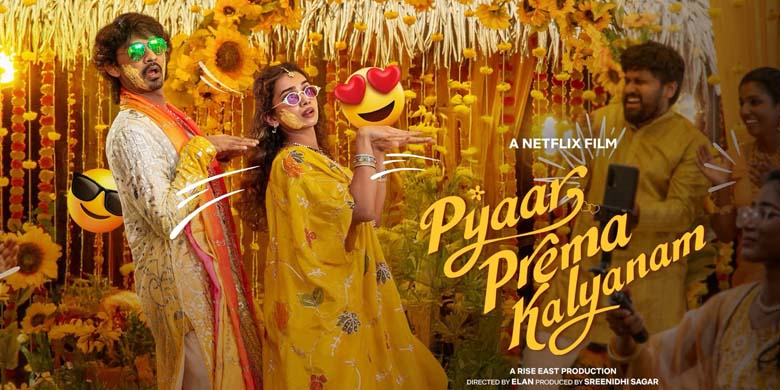
Pyaar Prema Kalyanam, streaming on Netflix, takes a familiar romantic-comedy setup and gives it an interesting twist by reversing one of the most deeply rooted traditions surrounding marriage — the expectation that the bride must leave her family home after the wedding.
Directed by Elan, the film stars Saanve Megghana and Elan in the lead, with Radhika Sarathkumar, Yogi Babu, M.S. Bhaskar, Geetha Kailasam, Elango Kumaravel, Senthil and Maran forming the supporting cast.
The film follows Pavithra, affectionately called Pavi, an independent and spirited influencer who is deeply attached to her family. When she gets married, she refuses to leave her home. Instead, her husband Elan moves into her house and becomes part of her family.
What initially appears to be a simple role reversal soon becomes the central source of both comedy and conflict.
Elan, a carefree Dubai-returned youngster, finds himself in unfamiliar surroundings. He has to adjust to his wife’s family, their routines and expectations while trying to establish his own place within the household.
The film works best when it derives humour from these everyday situations rather than relying on loud comedy or forced punchlines. Elan’s discomfort in his in-laws’ home and his struggle to understand the family’s routines provide several amusing moments.
A sequence involving his confusion between a ration card and an ATM card stands out for its simple, situational humour.
More importantly, the film uses Elan’s adjustment to explore the expectations placed on spouses after marriage. By reversing the traditional arrangement, the filmmaker allows the audience to see how difficult it can be for someone to leave familiar surroundings and enter an unfamiliar family environment.
The film does not turn this idea into a heavy social message. Instead, it uses humour and domestic situations to make its point.
Elan’s character also undergoes a gradual transformation. The easy-going youngster who initially appears somewhat directionless slowly learns to understand people, relationships and responsibilities. His journey from carefree bachelor to responsible husband provides the film with its emotional core.
Elan, who makes his acting debut while also directing the film, fits comfortably into the role. His charm comes largely from his natural performance and comic timing, particularly in ordinary domestic situations.
Saanve Megghana gives Pavi a confident and individualistic personality. She is not portrayed simply as a rebellious bride; her attachment to her family and her reasons for refusing to leave home give the character emotional grounding. Her chemistry with Elan adds warmth to the central relationship.
Radhika Sarathkumar is effective as Pavi’s mother, balancing affection and authority while bringing familiarity to the mother-in-law character.
Yogi Babu, M.S. Bhaskar, Geetha Kailasam, Elango Kumaravel, Senthil and Maran contribute to the family atmosphere without taking attention away from the lead pair.
Yuvan Shankar Raja’s music complements the film’s romantic and emotional portions and adds to its easy-going tone.
At around 126 minutes, Pyaar Prema Kalyanam remains brisk and largely engaging. The screenplay occasionally falls back on familiar family-comedy situations, and its exploration of gender roles is not particularly groundbreaking. Yet the film’s sincerity prevents its central idea from becoming preachy.
The film’s real strength lies in the question it quietly raises: does marriage necessarily require one person to leave their family behind, or can a couple create an arrangement that works for both of them?
By approaching that question through humour, romance and family dynamics rather than a serious social-drama treatment, Pyaar Prema Kalyanam delivers a pleasant and refreshing take on marriage traditions.