


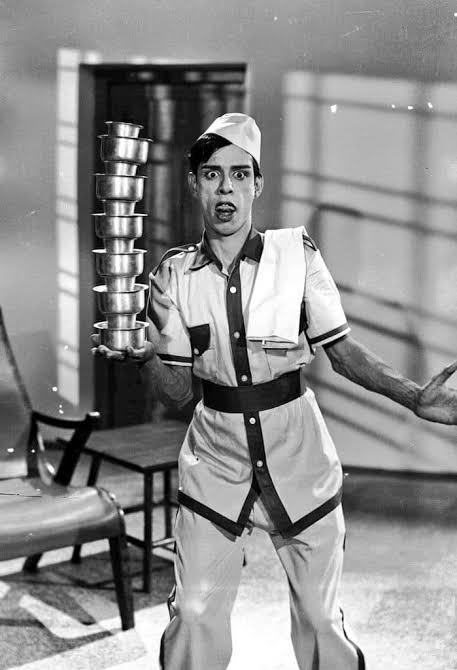
There are comedians who make us laugh at their jokes. And then there are actors like Nagesh, who could make us laugh simply by walking into a frame. A twitch of the eyebrow, a sudden change in expression, a peculiar walk, a perfectly timed pause or that unmistakable voice — everything became part of his comedy. On his birth anniversary today, Tamil cinema remembers an extraordinary performer who could turn laughter into an art form and, when required, transform that laughter into tears.
Born on September 27, 1933, in Dharapuram, Nagesh had an unlikely beginning for someone who would go on to become one of Indian cinema’s most recognisable performers. He worked as a clerk in the Indian Railways while nurturing his interest in theatre. His stage performances eventually brought him into the world of cinema, and he made his film debut in Manamulla Marudhaaram in 1958. His performance in Nenjil Or Aalayam brought him wider recognition, but it was his association with K Balachander that opened an important new chapter in his career.
Then came Server Sundaram in 1964. The story of a struggling hotel waiter who dreams of a better life had a special resonance because Nagesh himself had travelled an extraordinary journey from an ordinary job to the silver screen. The film established him not merely as a comedian but as a leading actor capable of carrying an entire story. Its success also demonstrated that Nagesh could seamlessly combine humour, emotion and drama.
His collaboration with K Balachander produced a remarkable string of films, including Neerkumizhi, Major Chandrakanth, Bama Vijayam, Anubavi Raja Anubavi, Ethir Neechal, Poova Thalaiya and Apoorva Raagangal. In Neerkumizhi, his tragicomic performance showed the emotional depth beneath the laughter. In Ethir Neechal, he played an ordinary man struggling against life’s circumstances, once again proving that his greatest strength was not merely comic timing but his ability to make audiences empathise with his characters.
If there was one performance that demonstrated the full range of Nagesh’s talent, it was Dharumi in Thiruvilayadal. His nervous, desperate temple poet, pleading for help and breaking down over his predicament, remains one of Tamil cinema’s most celebrated comic sequences. The performance is remembered not because of a conventional punchline, but because Nagesh understood the character so completely that every gesture and pause became part of the humour.
Kaadhalikka Neramillai brought another unforgettable Nagesh. His eccentric aspirations and comic energy fitted perfectly into the film’s breezy world. Anbe Vaa, Pattanathil Bhootham, Anubavi Raja Anubavi and Thillana Mohanambal further showcased his extraordinary ability to occupy different comic worlds without repeating himself. He could be mischievous, innocent, frustrated, arrogant, nervous or completely bewildered — and each variation felt distinctly Nagesh.
His association with the biggest stars of Tamil cinema also became part of his legacy. He acted alongside MGR and Sivaji Ganesan during the golden era of Tamil cinema and later shared the screen with Rajinikanth and Kamal Haasan. His career eventually extended across generations, with memorable appearances in films involving stars such as Vijay and Ajith Kumar as well. He was one of those rare performers who could walk into a scene dominated by a leading star and still leave the audience remembering his presence.
Nagesh’s versatility became even more evident when he stepped outside his familiar comic territory. His role as the antagonist in Apoorva Sagodharargal surprised audiences who had long associated him with comedy. He brought a chilling quality to the character, reminding everyone that the man who could produce effortless laughter was also a serious actor with considerable dramatic range.
The 1990s and 2000s saw another generation discovering Nagesh. Films such as Michael Madana Kamarajan, Nammavar, Avvai Shanmugi, Panchathanthiram, Vasool Raja MBBS and Imsai Arasan 23rd Pulikecei introduced his work to younger audiences in different shades. In Michael Madana Kamarajan, his comic presence became part of the film’s memorable ensemble, while Nammavar showed his ability to bring warmth and emotional weight to a supporting role. His later appearances proved that his screen presence had not diminished with age.
And there was another side to Nagesh that often gets overshadowed by his comedy — his dancing. His physicality was extraordinary. His long, lean frame, rapid movements and elastic body language gave his performances a rhythm of their own. Songs such as Kanni Nathiyoram from Neerkumizhi offered a glimpse of how naturally he could use movement as part of comedy.
Over a career that stretched from 1958 to 2008, Nagesh acted in more than 1,000 films, moving effortlessly between comedian, hero, supporting actor and antagonist. He worked across languages and generations, leaving behind a body of work that is unusually vast even by the standards of Indian cinema.
But numbers alone cannot explain the Nagesh phenomenon. His real achievement was creating a screen language that belonged entirely to him. He did not need elaborate dialogue to be funny. Sometimes a look was enough. Sometimes a pause was enough. Sometimes the way he stood in a room was enough. His comedy was physical, verbal and emotional — and often all three at once.
Nagesh passed away on January 31, 2009, aged 75. But the curtain never really came down on his career. Every time Thiruvilayadal, Server Sundaram, Kaadhalikka Neramillai or Michael Madana Kamarajan plays, Nagesh walks back into our lives — with the same voice, the same expressions and the same unmistakable timing.
He was not just a comedian who happened to act. He was an actor who could make comedy look effortless, turn vulnerability into laughter and make even a few seconds on screen unforgettable. Generations have changed. Comedy has changed. Cinema has changed. But when Nagesh appears on screen, one thing remains unchanged — we laugh. And that may be the finest tribute an entertainer can ever have.