


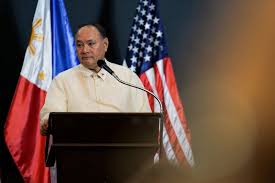
 Manila, Aug 27: In a stern rebuke, Philippine Defence Minister Gilberto Teodoro labeled China as the “biggest disruptor” of peace in Southeast Asia during a conference with the U.S. Indo-Pacific Command in Manila. This assertion comes amid escalating tensions between the two nations over disputed territories in the South China Sea.
The friction between Manila and Beijing intensified after China deployed a substantial naval presence, consisting of 40 ships, to block two Philippine vessels from delivering essential supplies to the BRP Teresa Magbanua, the largest coast guard ship in the Philippines. The confrontation occurred near Sabina Shoal, a disputed area within the highly contentious Spratly Islands, which is claimed by both countries.
Teodoro accused China of undermining regional stability, stating, “China… is the biggest disruptor of international peace in the ASEAN region.” His remarks highlight growing concerns in the Philippines and other Southeast Asian nations over China’s increasingly assertive behavior in the South China Sea, a critical maritime passage for global trade and security.
The recent confrontation on Monday marks the sixth reported incident between Chinese and Philippine forces this year, underscoring the fragile state of relations between the two nations. The Philippine coast guard condemned the “excessive force” employed by Chinese coast guard and navy ships, which were accompanied by 31 suspected militia vessels. These Chinese forces allegedly obstructed the delivery of food supplies, including an ice cream treat meant to mark National Heroes’ Day in the Philippines.
The Philippine government urged China to respect international law and to desist from actions that could exacerbate tensions. The Philippine coast guard reiterated its commitment to safeguarding the nation’s maritime interests, emphasizing the need for mutual respect and peaceful coexistence in the region.
In response, China’s coast guard claimed it had taken “control measures” against the Philippine ships, accusing them of intruding into Chinese waters. The Chinese authorities, however, did not provide specific details on the actions taken.
As both nations continue to bolster their military presence in the South China Sea, the risk of further confrontations looms large. The long-standing territorial disputes in this region also involve other ASEAN members, including Vietnam, Taiwan, Malaysia, and Brunei, all of whom have competing claims in the strategically significant area.
With the United States being a longstanding ally of the Philippines, there is growing concern that these incidents could potentially lead to a broader conflict, drawing in more regional and global powers.