


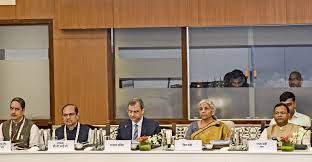
 The GST Council on Monday reached a broad consensus on reducing taxes on health and life insurance premiums, and a final decision on this would be taken in the November meeting.
The Council, chaired by Union Finance Minister Nirmala Sitharaman and comprising state counterparts, exempted from GST grants or funds received for R&D by central or state-affiliated universities or those institutions which have Income Tax exemptions.
Briefing reporters after the 54th meeting of the GST Council, Sitharaman said the Council has decided to set up two new Groups of Ministers (GoM) — one on medical and health insurance and the other on compensation cess.
The GoM on compensation cess would suggest to the Council how to go about the GST compensation cess, which is levied on luxury, sin and demerit goods, once the loans taken to meet the shortfall in revenue of states during Covid-affected years are repaid.
The government had borrowed Rs 2.69 lakh crore in fiscals 2021 and 2022 to make good states’ revenue loss and the GST Council had then decided to extend the compensation cess levy till March 2026 to repay the loan and interest.
Sitharaman said the loan and interest are expected to be repaid as early as December 2025, or January 2026. The GoM will decide on the future of the levy, how it would be apportioned between the Centre and states, and changes required in law as it cannot be called compensation cess any more.
The GST Council has decided to reduce tax rate on cancer drugs — Trastuzumab Deruxtecan, Osimertinib and Durvalumab from 12 per cent to 5 per cent, certain categories of namkeen to 12 per cent, from 18 per cent.