


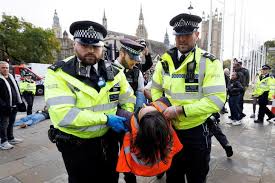
 London, Oct 6: The UK government announced plans to grant police forces enhanced authority to impose restrictions on repeated protests, particularly in light of recent demonstrations supporting the banned group Palestine Action. Home Secretary Shabana Mahmood stated that the new powers would allow senior officers to consider the “cumulative impact” of previous protests on local communities when determining conditions for public assemblies. This move follows a pro-Palestinian protest in London where nearly 500 individuals were arrested, highlighting concerns over public safety and community tensions.
The proposed changes involve amending Sections 12 and 14 of the Public Order Act 1986 to explicitly permit police to impose conditions such as relocation, time limits, and crowd size restrictions on protests that have caused repeated disorder. Mahmood emphasized the need to balance the fundamental right to protest with the safety and well-being of local communities, particularly religious groups who may feel threatened by ongoing demonstrations.
Civil liberties organizations have expressed concern over the potential for these new powers to suppress legitimate dissent. Groups like Liberty and Amnesty International argue that the measures could infringe upon democratic freedoms. In response, the group Defend Our Juries has pledged mass disobedience in November, labeling the government’s actions as an “extraordinary affront to democracy.”
As the UK government moves forward with these proposals, the balance between maintaining public order and protecting the right to protest remains a contentious issue, with ongoing debates about the implications for civil liberties and democratic engagement.