


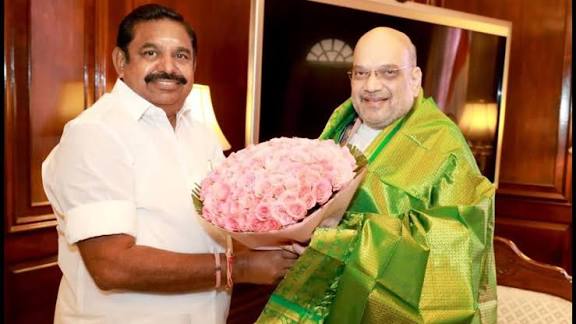
The political landscape of Tamil Nadu underwent a significant stress test this weekend as the “Natural Alliance” between the BJP and AIADMK faced a structural fracture. Between the closing ceremony of a marathon yatra in Pudukkottai and a calculated stand in Salem, the two potential allies appeared to be reading from entirely different scripts for the 2026 Assembly elections.
The Pudukkottai Remodel
Union Home Minister Amit Shah’s visit to Pudukkottai on Sunday served as more than a routine wrap-up of state party activities; it functioned as a public attempt to remodel the National Democratic Alliance (NDA) hierarchy. Shah’s declaration that an “NDA government” would be formed in Tamil Nadu by April 2026 signaled a departure from regional norms, where the AIADMK has traditionally occupied the primary role.
Labeling the tie-up a “Natural Alliance,” Shah leaned heavily on the mathematics of the 2024 Lok Sabha polls, suggesting that a combined vote share would have secured 36 seats. This statistical “I told you so” was paired with a sharp rhetorical focus on the DMK leadership. By addressing the Chief Minister as “Stalin Babu” and dismissing the prospect of a “Udhayanidhi coronation,” Shah positioned the BJP not merely as a supporting actor, but as the principal challenger to the ruling dynasty.
The Salem Slam
While the Pudukkottai stage was draped in saffron, Edappadi K. Palaniswami (EPS) utilized his presence in Salem to issue a firm rebuttal. The “Salem Slam” was characterized by a pointed omission of the NDA branding. EPS asserted that the “AIADMK will form the government on its own,” effectively rejecting the notion of a coalition cabinet or a senior-junior partnership with a national party.
For the AIADMK leadership, the suggestion of an “inclusive NDA”—which Shah hinted at by mentioning “other regional partners”—is viewed as a structural threat. This phrasing is widely interpreted as an open invitation to expelled factions led by OPS and TTV Dhinakaran. To EPS, a reunified alliance under a saffron umbrella looks less like a winning team and more like a Trojan Horse designed to dilute his singular authority over the Dravidian legacy.
A Partnership of Paradoxes
The weekend’s events have exposed a deep-seated tactical conflict. The BJP is banking on the belief that the AIADMK eventually requires central muscle and “National” branding to topple the DMK. Conversely, the AIADMK leadership appears convinced that conceding to a coalition government would be a slow-acting poison for the party’s independent Dravidian identity.
As the state moves into a crucial legislative week, the alliance remains a calculated collision. Shah has introduced a heavy dose of national ambition into the local cauldron, but the AIADMK is currently refusing to let it alter the flavor of its own campaign. The result is a distant dance where both partners are attempting to lead, but neither is listening to the other’s music.