


NT Tech Desk
Imagine this: one fine morning your bank account, WhatsApp chats, medical records, and even your favourite online shopping password all get served on a platter to someone you’ve never met. No virus, no hacker in a hoodie — just a quiet, super-smart machine doing what normal computers could never dream of. That day has a name in the tech world: Q-Day. And it’s closer than most of us want to admit.
The Clock is Ticking – What Exactly is Q-Day?
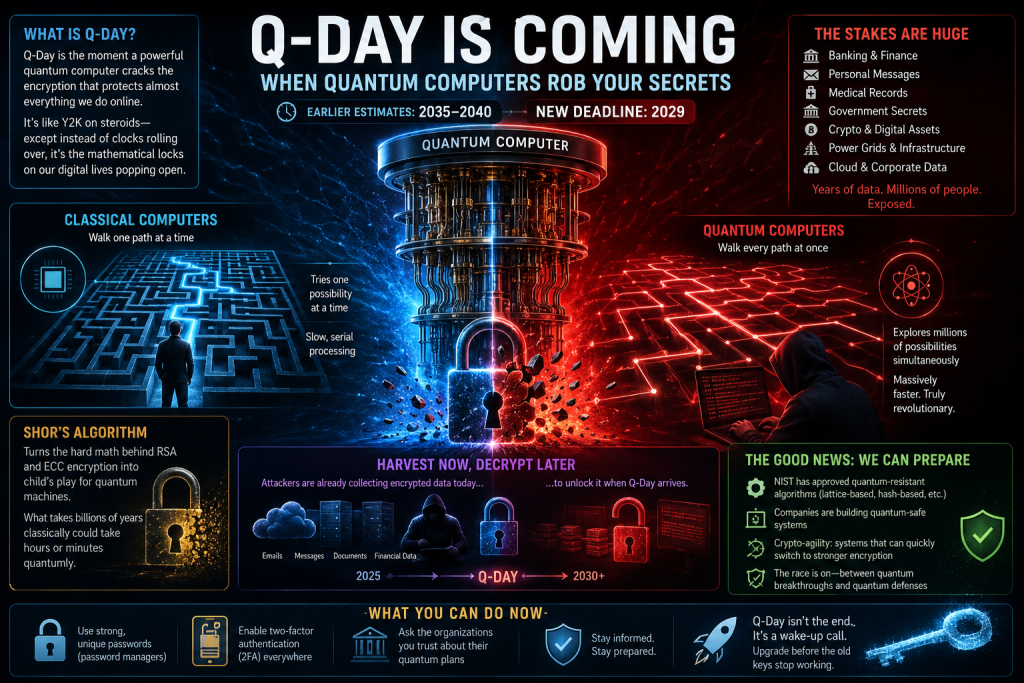
Q-Day is the moment when a powerful quantum computer cracks the encryption that protects almost everything, we do online today. Think of it as Y2K on steroids — except instead of clocks rolling over, it’s the mathematical locks on our digital lives popping open like cheap suitcases. Google and other big players recently pushed their internal deadline to 2029, sending a shiver through the cybersecurity world. Earlier estimates said 2035 or even 2040. Now the window is shrinking fast.
In simple terms, today’s encryption works because certain math problems (like factoring huge numbers) are ridiculously hard for normal computers. A quantum machine changes the game entirely. It doesn’t just work faster — it works differently. And when it arrives at full power, a lot of our “secure” data becomes yesterday’s news.
Classical Computers vs Quantum Cousins
Picture yourself lost in a giant maze with thousands of possible paths. A classical computer is like you walking one path at a time, trying each dead end patiently. It might take years to find the exit. A quantum computer? It walks every single path at the same time, thanks to something called superposition. Add entanglement — where particles stay mysteriously linked no matter the distance — and you get a machine that can explore millions of possibilities in parallel.
Think of it like guessing a four-digit ATM PIN. Your phone might try one number per second. A quantum beast tries all 10,000 combinations simultaneously. Your “strong” password that mixes letters, numbers and symbols suddenly looks as secure as a tissue paper lock on a bank vault. That’s the leap we’re talking about — not just faster, but fundamentally smarter in a spooky, physics-defying way.
Shor’s Algorithm and the Encryption Heist
The troublemaker with a name is Shor’s Algorithm. Invented in the 1990s, it turns the hard math behind RSA and ECC encryption (the stuff protecting your banking apps, WhatsApp, and government secrets) into child’s play for quantum machines. What used to take billions of years on a normal computer could take hours or minutes on a good quantum one.
Even scarier is “Harvest Now, Decrypt Later.” Bad actors — state-sponsored or otherwise — are already quietly scooping up encrypted data today and storing it like fine wine. They know that once Q-Day arrives, they can uncork those bottles and read everything at leisure. Your 2025 email about a sensitive deal? It might still be relevant in 2032. That’s the quiet horror of it.
The Cybersecurity Earthquake – What Gets Broken?
Almost everything that relies on public-key cryptography is at risk. Online banking, digital signatures, secure messaging, medical records, power grids, cryptocurrencies, cloud storage — the list is long and frightening. In one sweep, quantum computers could expose years of harvested intelligence, financial data, and personal secrets. Imagine a world where every past confidential conversation suddenly becomes public property. The economic and privacy fallout would be massive.
The Good News: We’re Not Doomed (Yet)
Fortunately, the good guys aren’t sleeping. NIST (the US standards body) has already approved the first batch of quantum-resistant algorithms — lattice-based, hash-based, and others that even quantum computers struggle with. Big companies are racing to roll them out. The trick is “crypto-agility” — building systems that can swap encryption methods quickly, like changing locks without rebuilding the entire house.
Governments and tech giants are pushing migration plans. The race is now between those building ever-better quantum machines and those hardening our digital defences. It’s a classic cat-and-mouse game, except both animals are evolving at warp speed.
The Human Angle & What You Should Do Now
At the end of the day, this isn’t just a tech story — it’s about how we protect our digital lives in a world that’s about to get much smarter and sneakier. Start small: use password managers, enable two-factor authentication everywhere, and push organisations you deal with to talk about their quantum migration plans.
Q-Day isn’t the end of the world. It’s a wake-up call. The quantum leap that promised miracles in medicine and science is also bringing a serious reality check for cybersecurity. The house may not always win in Las Vegas, but in the quantum casino, the smart players are already placing their bets on new, stronger locks.
The future is coming faster than we thought. Time to upgrade before the old keys stop working.