


Chennai, Oct 9:
Tamilaga Vettri Kazhagam (TVK), led by Chief Minister Vijay, has scored a significant electoral victory by winning the Madurantakam and Dharapuram Assembly by-elections, reinforcing its position as a formidable political force in Tamil Nadu.
The DMK emerged as the runner-up in both constituencies, while the AIADMK was pushed to third place, marking a setback for the principal Opposition party.
The results provided a major boost to the five-month-old TVK government, which faced a concerted campaign by Opposition parties accusing it of failing to fulfil its poll promises and losing public confidence. The victories have strengthened Vijay’s political standing and given his party fresh momentum ahead of further by-elections expected in the State.
The by-elections, held on October 6, were necessitated by the resignation of two rebel AIADMK MLAs who subsequently joined the TVK. The ruling party renominated both legislators from their respective constituencies, a decision that became a major campaign issue, with the Opposition accusing Vijay of encouraging political defections and horse-trading.
However, the electoral verdict has enabled TVK to retain both seats, with its candidates securing victories against the DMK and AIADMK nominees.
In Madurantakam, TVK candidate K. Maragatham Kumaravel registered a decisive victory, establishing a substantial lead over DMK candidate I. Paranthaman. The constituency witnessed a largely one-sided contest in favour of TVK, with Maragatham maintaining her lead from the initial rounds of counting.
AIADMK candidate K. Kanitha Sampath remained in third place.
Naam Tamilar Katchi candidate K. Janakiraman secured just over 1000 votes while CPI(M) candidate P. Suganthi polled fewer votes, leaving both far behind the leading candidates.
The result was a setback for the AIADMK, which had won the constituency in the previous election but failed to retain it after its former MLA joined TVK. The DMK, despite finishing second, could not mount a serious challenge to Maragatham’s lead as counting progressed.
Dharapuram witnessed a more closely fought contest, with TVK candidate P. Sathyabama overcoming an early challenge from AIADMK nominee K. Bhanumathi before consolidating her position in the later rounds.
The contest initially saw the lead fluctuate between TVK and the AIADMK. Sathyabama held a narrow advantage during the first two rounds, but Bhanumathi moved ahead and maintained a lead of around 600 to 700 votes until the fifth round.
The trend changed from the sixth round onwards, when Sathyabama regained the lead and gradually increased the margin. By the end of the 14th round, she had secured 41,327 votes and established a lead of 8,064 votes.
The race for second place also witnessed a significant shift. DMK candidate S. Suganya moved ahead of Bhanumathi, pushing the AIADMK into third place.
Naam Tamilar Katchi candidate M. Karthika secured 3,361 votes, while CPI candidate P. Lakshmanan polled 734 votes.
The contrasting counting trends in the two constituencies highlighted the different electoral challenges faced by TVK. While Maragatham maintained a comfortable lead throughout the counting process in Madurantakam, Sathyabama had to overcome an initial setback in Dharapuram before establishing a decisive advantage.
The victories were particularly significant because both TVK candidates had previously been elected on AIADMK tickets before resigning and joining Vijay’s party. Their renomination by TVK had triggered criticism from the DMK and AIADMK, which accused the ruling party of relying on political turncoats despite its promise to bring about a change in Tamil Nadu’s political culture.
The CPI and CPI(M), which extend outside support to the Vijay government, also contested the by-elections independently, fielding candidates in Dharapuram and Madurantakam respectively. Their decision to enter the fray added to the complexity of the contests, which were initially projected as five-cornered battles.
However, the counting trends and final electoral outcome indicated that the contest was primarily between TVK, the DMK and the AIADMK. The poor performances of the smaller parties further underlined the challenge they face in converting their political presence into electoral support in constituencies dominated by larger parties.
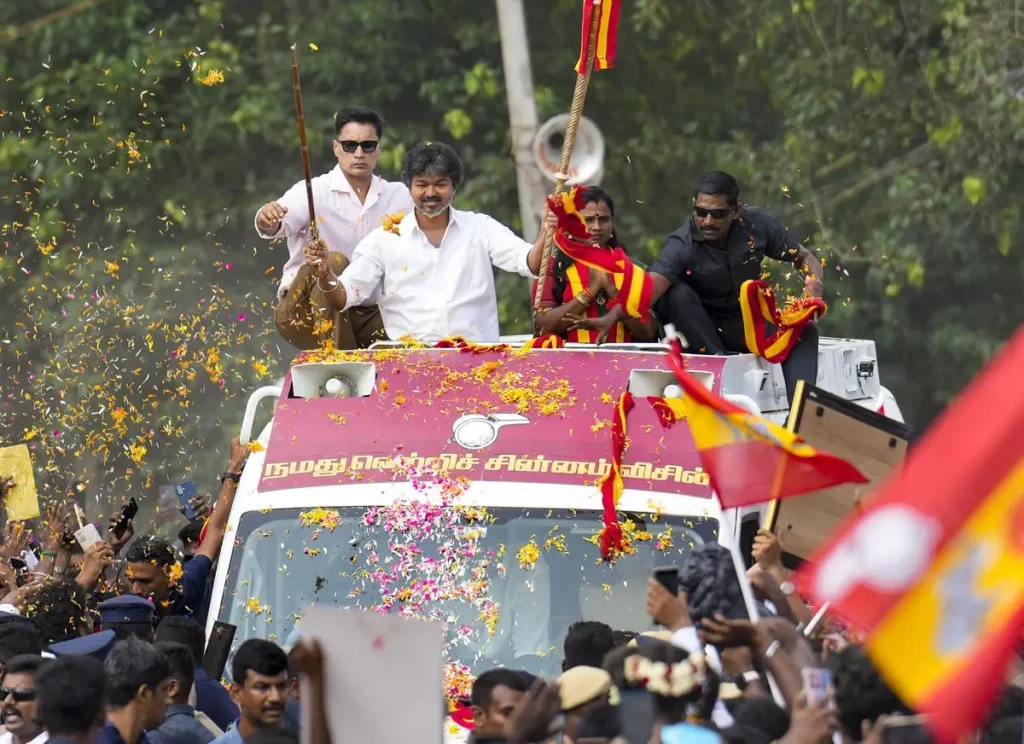
The victories triggered celebrations at the TVK headquarters in Panayur on the East Coast Road in Chennai. Party cadres burst crackers, distributed sweets and danced to drumbeats as the trends confirmed the party’s strong position in both constituencies.
The by-elections were widely viewed as a litmus test for the five-month-old TVK government. Opposition parties had targeted the administration over alleged failures on several fronts, non-fulfilment of electoral promises and a perceived decline in public confidence. The results, however, have given Vijay and his party a significant political boost.
For the DMK, finishing second in both constituencies offers little consolation, particularly as it failed to prevent TVK from retaining the seats despite the controversy surrounding the candidates. The party will have to examine its campaign strategy and assess the factors that enabled Vijay’s candidates to prevail.
The AIADMK faces an even more difficult situation. Having won both constituencies in the previous election, the party has now lost them to the very candidates who left its ranks to join TVK. Its relegation to third place in both seats raises fresh questions about its ability to retain its traditional support base and challenge the ruling party effectively.
For Vijay, the twin victories strengthen TVK’s claim to be a major force in Tamil Nadu politics. They also provide a morale boost ahead of the next round of electoral contests, with by-elections to five more constituencies potentially on the horizon, subject to the outcome of court proceedings.