


MOHALI, November 6:
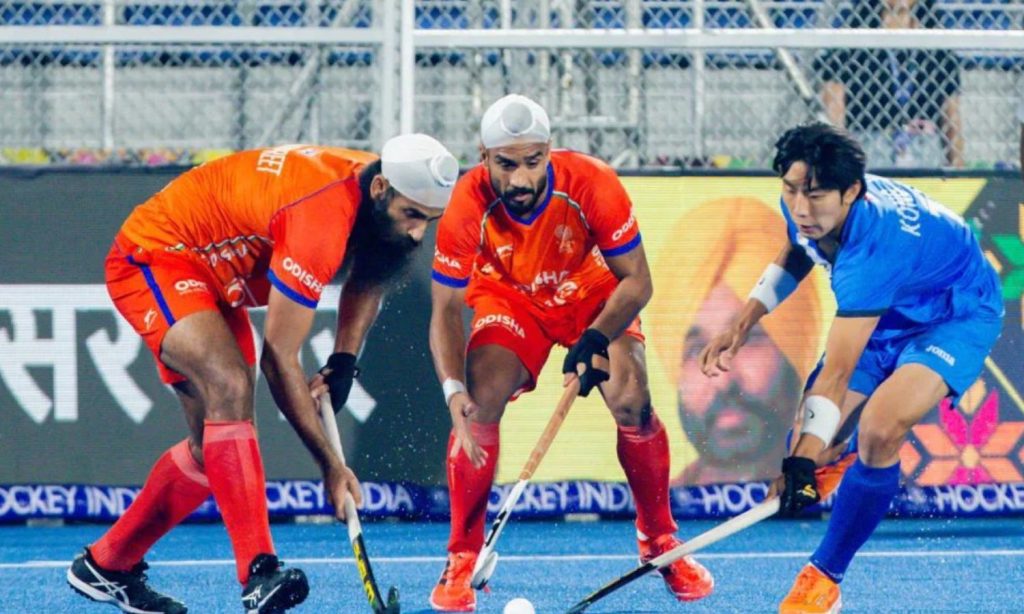
India overcame an early setback to defeat Japan 4-1 in the final of the 2026 Asian Champions Trophy on Thursday, securing a record-extending sixth title and completing an unbeaten campaign in front of a packed crowd at the Olympian Balbir Singh International Hockey Stadium.
Shilanand Lakra, Dilpreet Singh, Jugraj Singh and Sukhjeet Singh scored in the second half as the hosts turned around a frustrating contest to retain the championship. Japan, which had taken an unexpected early lead, eventually struggled to contain India’s attacking surge after holding firm for more than two quarters.
The final, however, was far from straightforward for the defending champions.
Japan stunned the home side in the third minute when Kazumasa Matsumoto capitalised on space outside the Indian circle. Advancing towards goal, Matsumoto unleashed a powerful strike through a narrow gap between the near post and goalkeeper Suraj Karkera to put Japan ahead.
The early goal forced India into an extended attacking pursuit, but the hosts found it difficult to convert their territorial dominance into meaningful opportunities. Japan maintained a disciplined defensive structure, crowded the circle and repeatedly disrupted India’s attacking combinations.
Despite spending much of the opening half in the opposition territory, India struggled with its finishing and execution in the final third. The forwards missed several opportunities, while Japan’s goalkeepers Kisho Kuroda and Takumi Kitagawa produced important interventions to preserve the advantage.
India’s attacking statistics reflected its dominance without the necessary end product. The hosts recorded 22 circle entries and 12 shots on goal, compared with Japan’s seven entries and two shots. Yet the scoreline remained unchanged for much of the contest.
India’s first penalty corner arrived only in the 33rd minute, underlining Japan’s defensive discipline. The breakthrough eventually came in the 42nd minute when the hosts capitalised on a penalty-corner variation. Shilanand Lakra reacted to the loose ball and struck it into the net to restore parity.
The equaliser changed the complexion of the final. With Japan’s defensive resistance finally broken, India began finding greater fluidity in possession and creating more decisive attacking opportunities.
Dilpreet Singh, Jugraj Singh and Sukhjeet Singh added the remaining goals as India completed a commanding comeback to secure the trophy.
The victory also reinforced India’s position as the dominant force in the competition. With six titles, the country extended its record as the tournament’s most successful team, while the unbeaten run added further significance to its campaign.
For Japan, the defeat came despite an impressive defensive performance through much of the match. Its early attacking intent and disciplined organisation troubled India, but maintaining that intensity for the full 60 minutes proved difficult once the equaliser arrived.
Earlier in the day, Malaysia defeated South Korea 5-2 to claim the bronze medal.
For India, the championship provides another boost to its preparations for the broader international hockey calendar. More importantly, the final demonstrated both sides of the team’s performance: its ability to dominate possession and generate chances, as well as the need to improve finishing and attacking efficiency against well-organised opponents.