

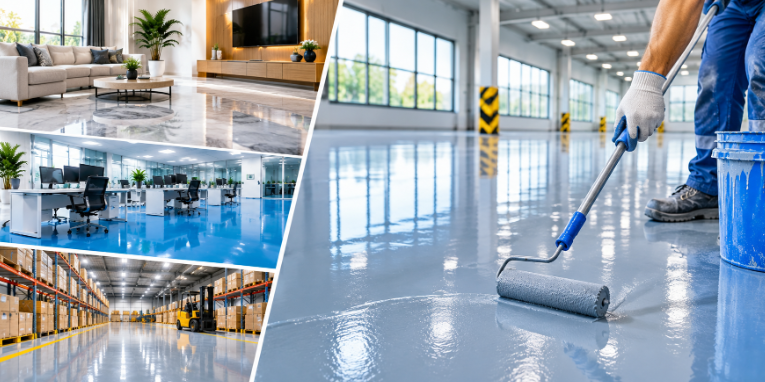
Industrial and commercial properties require flooring that can withstand daily operational challenges. Manufacturing units, warehouses, automobile workshops, retail stores, and distribution centres experience different types of traffic and environmental exposure.
Traditional concrete floors may develop dust, stains, cracks, and surface deterioration over time if they are not properly maintained.
To address these challenges, many businesses are considering epoxy flooring systems as an alternative. The growing interest in Epoxy Flooring in Gurgaon and Epoxy Flooring in Delhi reflects the importance of durable flooring solutions in developing commercial and industrial infrastructure.
Understanding Industrial Epoxy Flooring
Industrial epoxy flooring is a resin-based coating system applied over prepared concrete surfaces.
The system is created by combining epoxy resin and a hardening agent. After application and curing, it forms a hard protective layer.
Depending on the formulation, industrial epoxy systems can offer resistance to abrasion, selected chemicals, stains, and regular operational traffic.
Different facilities require different coating specifications, so selecting the right system is essential.
Why Businesses Are Considering Epoxy Flooring
1. Improved Surface Durability
Industrial floors experience continuous movement from employees, machinery, trolleys, and vehicles.
Specialised epoxy coatings can protect concrete surfaces against regular wear and abrasion. However, the coating system must be selected according to the actual load and traffic conditions.
This makes epoxy a useful consideration for factories, warehouses, and workshops.
2. Easier Cleaning and Maintenance
Dust and dirt can accumulate on untreated concrete surfaces.
Epoxy flooring creates a smoother and less porous surface, making routine cleaning easier. Its seamless nature also reduces the number of joints where dirt can collect.
This feature can be particularly valuable in facilities where cleanliness is important.
3. Resistance to Selected Chemicals
Certain industrial environments involve oils, cleaning chemicals, solvents, and other substances.
Specialised epoxy formulations can provide resistance to selected chemical exposures. However, not every epoxy product is resistant to every chemical.
Businesses should check chemical compatibility with the coating manufacturer before installation.
4. Better Workplace Organisation
Different floor colours can be used to identify work zones, pedestrian pathways, storage areas, and equipment locations.
Coloured coatings and floor markings can help businesses organise operational spaces more effectively.
The marking system should be designed according to workplace safety requirements.
Applications Across Different Industries
Manufacturing Facilities
Manufacturing units often require flooring that can withstand machinery movement, abrasion, and selected chemical exposure.
Industrial epoxy systems can provide a protective layer over concrete, depending on the operating environment.
Warehouses and Distribution Centres
Warehouses experience frequent movement of forklifts, pallet trucks, and storage equipment.
Appropriate epoxy flooring systems can improve surface protection and make routine cleaning easier.
Automobile Workshops
Automobile workshops frequently deal with oil, grease, vehicle movement, and cleaning activities.
Specialised coatings can help protect concrete surfaces from selected automotive fluids and regular wear.
Hospitals and Healthcare Facilities
Healthcare facilities require flooring that supports regular cleaning and hygiene practices.
Seamless epoxy systems may be considered for selected areas, subject to hygiene, slip-resistance, and regulatory requirements.
Retail Stores and Showrooms
Commercial showrooms often prioritise both durability and visual appeal.
Decorative epoxy finishes can create a modern appearance while providing a protective surface.
Factors to Evaluate Before Installation
Businesses should carefully evaluate the existing concrete floor before choosing an epoxy system.
Moisture, cracks, contamination, and previous coatings can affect adhesion and long-term performance.
Professional surface preparation is therefore essential.
The facility’s daily operations should also be considered. Heavy machinery, chemical exposure, temperature changes, and vehicle movement may require specialised coating specifications.
Choosing the Right Epoxy Flooring System
There are several types of epoxy flooring, including self-leveling systems, high-build coatings, decorative epoxy, and specialised industrial formulations.
Each option serves a different purpose.
For example, a decorative coating may be suitable for a showroom but may not provide the required performance for a heavy manufacturing environment.
Companies evaluating Epoxy Flooring in Delhi should request technical details about coating thickness, chemical resistance, curing time, and expected maintenance.
Importance of Professional Installation
Industrial flooring projects require proper planning because installation activities may affect business operations.
A professional contractor should inspect the existing floor, recommend suitable preparation methods, and explain the installation schedule.
The process generally includes concrete grinding, crack repairs, cleaning, priming, coating application, and curing.
Allowing sufficient curing time is essential before reopening the facility to regular traffic.
Long-Term Value of Epoxy Flooring
The value of flooring should not be measured only by its initial installation price.
Businesses should also consider maintenance expenses, repair requirements, downtime, and the expected service life of the flooring system.
A suitable epoxy coating may help reduce certain maintenance challenges and improve the usability of industrial spaces.
However, actual performance depends on installation quality, product selection, and operating conditions.
Conclusion
Industrial and commercial facilities require flooring solutions that balance durability, maintenance, safety, and appearance.
Epoxy flooring offers several useful properties that make it suitable for different industrial and commercial applications.
Businesses researching Epoxy Flooring in Gurgaon should evaluate their operational requirements before choosing a coating system. Similarly, selecting Epoxy Flooring in Delhi requires comparing product specifications, installation quality, and long-term maintenance needs.