

Erode (West):Loom Lines, River Wind and the Discipline of the Kongu Vote

- Tamil
- Hindi
- Malayalam
- Kannada
- Telugu

Constituency No. 99 | Erode District | General
Erode (West) is not the birthplace of Periyar — that distinction belongs to the eastern half — but it breathes the same air of reform, trade and relentless industry. If Erode (East) carries ideological ancestry more explicitly, Erode (West) carries the industrial muscle and residential sprawl that complete the city’s political character.
This is a constituency of looms and ledger books, of Mariamman festivals and market lorries, of disciplined voting patterns and closely watched margins.
Erode (West) does not deliver surprises lightly. It delivers signals.
Periyar’s Shadow Across the City
Though Periyar’s memorial house lies in Erode (East), his ideological presence permeates the entire city, including the western segment. Public meetings, statues and institutional names across Erode keep his reformist vocabulary alive.
In western Tamil Nadu’s Kongu belt — often stereotyped as conservative — Periyar’s imprint adds a distinctive paradox: reformist rhetoric layered over structured social discipline.
Erode (West) is shaped by that paradox.
Temples and Civic Anchors
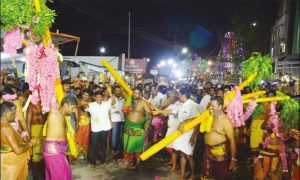
The constituency includes active neighbourhood shrines and religious institutions that structure community life. The broader city’s Periya Mariamman Temple remains a central spiritual magnet, drawing devotees from both East and West segments.
The hill shrine of Thindal Murugan Temple, located along the western corridor, is a visible landmark — a spiritual outpost overlooking expanding residential stretches.
Temple festivals and local religious gatherings function as informal civic forums. Political outreach often intersects these spaces.
Faith here is active, not ornamental.
Turmeric, Textiles and Trade Corridors
Erode (West) is closely tied to the city’s textile trade and agricultural markets. Turmeric, cotton yarn and woven products move through warehouses and transport depots that define the constituency’s economic rhythm.
The regulated turmeric trade — symbolised by the ETMA Turmeric Market Complex — feeds into wholesale and export channels.
Power loom clusters and ancillary units provide employment to thousands. Electricity tariffs, yarn prices and GST compliance affect livelihoods directly.
Erode (West) measures policy in profit and loss.
River, Roads and Residential Spread

The Cauvery river system influences irrigation in surrounding rural belts. Though not riverfront in the dramatic sense, the western stretches benefit from canal-fed agriculture and tank irrigation.
Rapid urban expansion has converted agricultural land into plotted developments. Residential colonies continue to expand outward from the city core.
Road relaying, drainage expansion and waste management are recurring civic demands.
Growth is visible — and scrutinised.
The Electoral Ledger: 2011, 2016, 2021
Erode (West) has witnessed decisive and narrow contests alike.
2011
Winner: K. V. Ramalingam (AIADMK) — 1,01,212 votes
Second: N. K. K. Periasamy (DMK) — 79,654 votes
Third: R. Chandrasekar (DMDK) — 26,438 votes
Margin: 21,558 votes
2016
Winner: K. V. Ramalingam (AIADMK) — 82297 votes
Second: Muthusamy S (DMK) — 77391 votes
Third: EaswaraMurthy M (KMDK) — 7477 votes
Margin: 4906 votes
2021
Winner: S. Muthusamy (DMK) — 1,00,757 votes
Second: K. V. Ramalingam (AIADMK) — 78,668 votes
Third: Chandrakumar .P (Naam Tamilar Katchi) — 13,353 votes
Margin: 22,089 votes
The axis shifted decisively.
Following his 2021 victory, S. Muthusamy entered the state Cabinet, giving Erode (West) ministerial representation in the DMK government.
This constituency has demonstrated both landslide comfort and razor-edge tension within a decade.
Industrial Middle Class

Unlike purely agrarian seats, Erode (West) houses a significant industrial middle class — small entrepreneurs, textile traders, transport operators and salaried professionals.
They track industrial policy, infrastructure announcements and regulatory clarity closely. Export climate and domestic demand cycles influence political mood.
Economic optimism here translates quickly into political consolidation.
Urban Civic Expectations
As the western residential sprawl expands, civic performance becomes central:
Stormwater drainage upgrades.
Road widening and traffic regulation.
Water supply management during peak summer.
Waste disposal efficiency.
Residents’ associations and trade bodies maintain active engagement with elected representatives.
This is a constituency that expects visible execution.
Cuisine and Kongu Identity
Kongu cuisine defines local flavour — arisi paruppu sadam, pepper-infused gravies and ragi-based preparations. Roadside eateries near market hubs serve hearty meals aligned with labour-intensive lifestyles.
Food culture here is functional and robust, reflecting the region’s work ethic.
Cultural and Political Discipline
Western Tamil Nadu is often noted for structured voting behaviour. Erode (West) exemplifies that pattern. Organisational networks at booth level, trade associations and community alignments shape turnout patterns.
Campaign noise rarely overrides groundwork.
Margins respond to discipline.
What Decides Here
Three determinants shape Erode (West)’s electoral direction:
Industrial and Trade Stability.
Textile and turmeric markets influence confidence.
Urban Governance Delivery.
Expanding residential zones demand infrastructure.
Organisational Cohesion.
Tight contests hinge on booth precision.
Erode (West) does not oscillate impulsively. It recalibrates through structure.
Closing Frame
Looms hum in industrial sheds. Turmeric sacks stack in warehouses. Devotees climb the Thindal Murugan hill as traffic moves steadily below. Periyar’s intellectual legacy hangs over the city, even where temple bells ring.
Erode (West) is the industrial conscience of a reformist town — pragmatic, measured and attentive to detail.
When it casts its vote, it does so with the steadiness of a trader closing accounts — carefully, conclusively.
In this Kongu heartland constituency, mandate is calculated — not declared.