


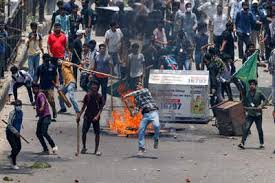
 Dhaka, July 19: The violent protests in Bangladesh over the controversial quota system for government jobs have intensified, leading to the death of at least 32 people and significant property damage. The unrest escalated on Thursday when protesters set ablaze a building belonging to the state broadcaster, Bangladesh Television (BTV), and torched several vehicles.
The protests began as a response to the government’s quota system, which reserves more than half of the public sector jobs for specific groups, including descendants of veterans from Bangladesh’s 1971 liberation war. University students, who have been rallying for over a week, argue that this system unfairly limits opportunities for other qualified candidates. Despite police efforts to disperse the crowds using rubber bullets, tear gas, and noise grenades, the protesters remained undeterred.
On Thursday, the situation took a dramatic turn when demonstrators overwhelmed riot police and chased them to BTV’s headquarters in Dhaka. The protesters set fire to the channel’s reception building and several parked vehicles. Although several individuals were trapped inside the BTV office, they were eventually evacuated safely. The chaos and destruction highlighted the intensity of the students’ anger and frustration.
The violence prompted the government to take drastic measures. Authorities shut down metro stations in the capital and ordered an internet blackout to curb the spread of information and prevent further mobilization of protesters. According to the outage monitor NetBlocks, Bangladesh experienced a “near-total internet shutdown,” significantly impacting communication and access to information.
In response to the escalating violence, the government deployed Border Guard Bangladesh personnel across the country, including the capital, to restore order. Prime Minister Sheikh Hasina appeared on television on Wednesday, condemning the “murder” of protesters and vowing to punish those responsible regardless of their political affiliations. However, her address did little to calm the situation, as clashes continued the following day.
Adding to the turmoil, the government ordered all schools and universities to shut down indefinitely. Human rights groups have criticized the Hasina administration for its heavy-handed approach and suppression of dissent. Meanwhile, the junior minister for ICT, Zunaid Ahmed Palak, justified the internet ban, stating that social media had been “weaponized” to spread rumours and disinformation.
In a bid to resolve the crisis, Law Minister Anisul Huq announced that the government would hold a dialogue with the protesting students. Prime Minister Hasina entrusted him and Education Minister Mohibul Hassan Chowdhury with facilitating the discussions. However, a spokesman for the protesters later declared that they no longer sought dialogue, demanding instead the immediate abolition of the quota system through a gazette notification. As tensions remain high, the situation in Bangladesh continues to be volatile and uncertain.