


Sriharikota (AP), July 19:
After a 35 minute delay India’s first privately developed orbital-class rocket, Vikram-1 was sucessfully launched in its intended orbilt in its maiden flight on Saturday, marking a major milestone in the country’s space programme and the next decisive step in India’s journey to becoming a global spacefaring nation.
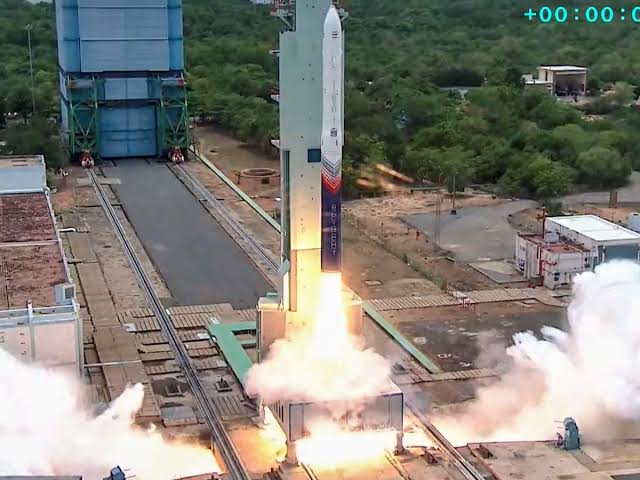
Developed by Hyderabad-based Skyroot Aerospace, the first test flight, named Mission Aagaman (Arrival), took off from the First Launch Pad at 1205 hrs from the Satish Dhawan Space Centre here at 1205 hrs.
After a 36 hours smooth countdown, the 22 m tall rocket, with a lift off mass of 40 tonnes, witnessed a glitch after the automated launch sequence was initiated.
After the glitch was rectified, a fresh countdown of 20 minutes was initiated for final check of all systems after which the rocket took off majestically at 1205 hrs from the First Launch Pad amid cloudy skies.
After a flight duration of 15 minutes and ignition and separation of all stages, the rocket precisely reached its intended orbit at a height of 450 km and at an inclination of 60 degrees, as joyous scenes were witnessed at the Mission Control Centre with ISRO Chairman Dr V Narayanan exchanging pleasantries with other scientists.
“Vikram-1 Mission successfully accomplised”, ISRO said after the rocket reached its orbit.
Among the mission’s symbolic payloads is a handwritten postcard from Prime Minister Narendra Modi bearing the words “Vande Mataram”.
Ahead of the launch, Modi hailed the Vikram-1 mission as a historic new frontier in India’s space journey. This mission highlights the talent, determination and entrepreneurial spirit of the country’s youth and also shows how India’s space-sector reforms are unlocking new opportunities for innovation and enterprise.
“Among the payloads on Vikram-1 Test Flight-1 is something truly special—a handwritten postcard from Hon’ble Prime Minister Shri @narendramodi with the words ‘Vande Mataram’,” the company said.
The launch heralded a new era for India’s space sector by becoming the country’s first privately developed orbital-class rocket to attempt an orbital mission, opening the door for greater private sector participation in India’s expanding space programme.
ISRO said Mission Aagaman is more than a launch. It marks the arrival of a new chapter for India’s private space ecosystem. Vikram-1 represents the next decisive step in India’s Journey to becoming a global spacefaring nation.
Vikram-1 carred international and domestic technology demonstrators as payloads, including an 18K gold rocket containing micro-sculptures of Nobel Laureate Sir C. V. Raman, Dr Vikram Sarabhai, and former President and distinguished space and missile scientist, Dr. A. P. J. Abdul Kalam, smaller than a grain of rice, a diamond jewellery piece, and Skyroot’s own SCOPE satellite.
The microart gold rocket payload, created by Telangana’s Ajay Kumar Mattewada, features sculptures measuring 700 microns by 980 microns. The artwork honours three figures central to India’s scientific and space heritage, including Sarabhai, after whom the Vikram- 1 rocket was named.
The Cosmic Bloom, developed by Karnataka-based Cosmos Diamonds, is a 16.95 carat diamond lotus jewellery piece shaped like a blooming flower. Payloads also include SOLARAS, a 1U CubeSat from Karnataka-based Grahaa Space; Embrace, an in-orbit robotic arm demo from Telangana-based Cosmoserve Space; and uD3PP and mD3PRN, in-orbit demonstration payloads from Germany’s DCubed.
Vikram-1 is a seven-storeyed tall multi-stage rocket that featured an all-carbon composite structure and reliable solid fuel boosters and advanced 3D-Printed Liquid Engines. The rocket was designed to carry small satellites weighing up to 350 kg into a LEO and inject them at about 450 km altitude, and satellites up to 260 kg to Sun-synchronous Orbit.
This is the second mission for Skyroot after the successful launch of the suborbital launch vehicle Vikram-S, India’s first privately built rocket to space on November 18, 2022. Vikram- 1 is its maiden suborbital test flight, which was launched from Sriharikota.
This historic mission, named Prarambh (“The Beginning”), marked the first-ever private rocket launch from India. The single-stage solid rocket reached an altitude of about 89.5 km in 155 seconds, as planned. This sounding rocket carried three payloads, ISRO said. The payloads are BAZOOMQ Armenia, Space Kidz India, and N-Space Tech India.
Following a nominal ascent phase, the vehicle completed its mission profile, splashing down 125 km downrange in the Bay of Bengal.
The mission validated key technologies for the Vikram-series of orbital launchers, including solid propulsion systems, carbon composite structures, avionics, and telemetry. This successful demonstration has paved the way for the orbital launch vehicle, Vikram-1.
According to Skyroot, the primary objective of Mission Aagaman is to gather critical in-flight performance data across all major systems of the Vikram-1 rocket, including propulsion, stage separation, guidance, navigation, control, and overall vehicle performance. The data will be used to validate the vehicle’s design and support the development of a reliable, high-frequency commercial launch programme.