


Chennai, July 24:
Every 3.5 minutes, someone in India dies in a road accident. With over 170,000 lives lost on Indian roads each year, and only one in five patients reaching trauma care within the critical “golden hour,” urban congestion and geographic distance remain some of the biggest barriers to survival — not the absence of medical expertise.
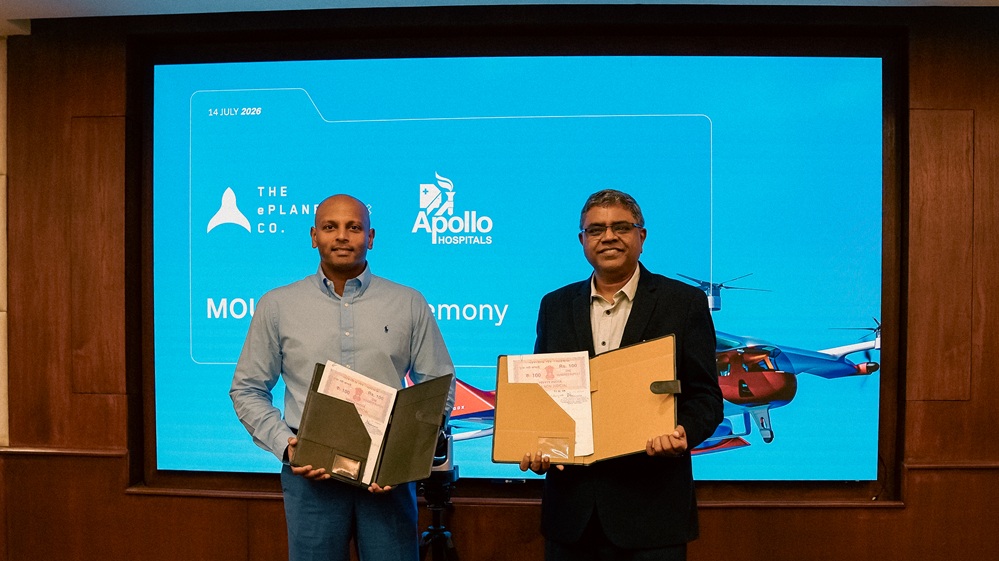
To help close this gap, Ubifly Technologies Private Limited (The ePlane Company) and Apollo Hospitals have signed a Memorandum of Understanding to bring electric air ambulances and medical delivery drones into India’s emergency healthcare system, connecting emergency patients across high-density urban corridors and remote access areas directly to the trauma care they need, without the delays of urban traffic or the expense of traditional helicopter transfers.
As part of the collaboration, Apollo has indicated its intent to explore the possibility for orders for e200x air ambulances and Amber Wings’ medical delivery drones.
The MoU also outlines the possibility of a future strategic investment by Apollo in ePlane, subject to future agreement on terms. Both parties intend to work with India’s Directorate General of Civil Aviation and other relevant authorities to help bring this vision to life, alongside continued discussions on infrastructure needed to support these operations.
“India loses far too many lives simply because help cannot arrive in time,” Dr Prathap C Reddy, Chairman, Apollo Hospitals Group said. ”This collaboration with ePlane reflects our commitment to bringing Apollo’s clinical excellence to every corner of the country, however remote”, he added.
“Every minute matters when someone’s life is on the line,” Prof. Satya Chakravarthy, Founder and CTO of ePlane Company. “Working with Apollo Hospitals allows us to explore how our electric aircraft and drones can help close the gap between accident and treatment, especially for the millions of Indians living far from specialized trauma care.”
For trauma, cardiac, and stroke patients, the first hour after an emergency often determines the difference between recovery and tragedy. Yet today, patients frequently lose that hour to traffic, distance, and the need to stabilise at any nearby facility before being moved again to specialised trauma care, thereby losing precious time. This collaboration is designed to change that with a faster, more direct path from the point of emergency to definitive care.
The collaboration brings together air and road ambulance network complementing one another: ePlane’s e 200X aircraft Electric Air Ambulances has been designed for rapid inter-hospital transfers, trauma response, cardiac and stroke emergencies, and organ transport, moving patients up to 7 times faster than road transport – at a fraction of the cost of a traditional helicopter transfer.
Through its subsidiary Amber Wings, ePlane’s unmanned aerial vehicles are designed to rapidly move blood products, organs, vaccines, medicines, and diagnostic samples between facilities – cutting critical delivery times from hours to minutes. These combination creates the foundation for a connected emergency response system – one that could bring life-saving care to some of India’s most congested and difficult-to-access cities.