


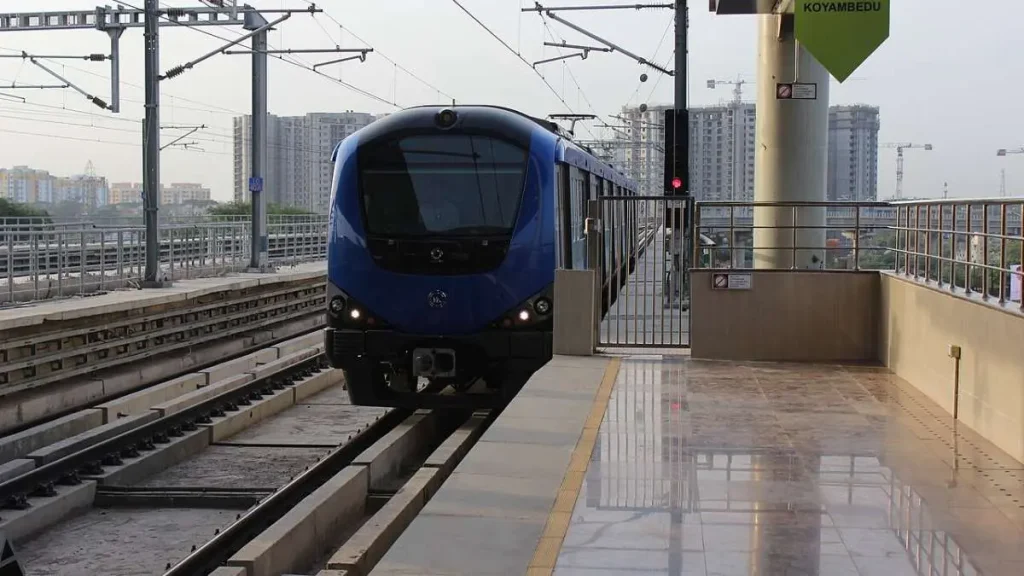
Chennai, Oct 7: The much-awaited Poonamallee–Vadapalani stretch of Chennai Metro’s Phase II project is set to bring a major improvement in public transport connectivity for residents of western Chennai, with trains planned to operate at 10-minute intervals initially.
The new metro service is part of Corridor 3 of Chennai Metro Phase II, which will eventually connect Poonamallee with Lighthouse. The corridor will comprise both elevated and underground sections. The Poonamallee–Vadapalani section, forming the first phase of the corridor, has been completed and is ready for service.
The service is scheduled to be inaugurated by Prime Minister Narendra Modi on October 11. Chief Minister Vijay is also expected to participate in the inauguration. The opening had been delayed by around six months.
The new service is expected to significantly benefit commuters from Poonamallee and surrounding western suburbs who travel towards Vadapalani and other parts of the city. The extension will provide an additional mass-transit option for people who currently depend heavily on buses and road transport.
According to Chennai Metro officials, 15 trains will initially be operated on the route. Each train will have three coaches and can accommodate up to 900 passengers. A total of 36 trains have been procured for the Phase II network, with the remaining trains available for deployment as passenger demand increases.
Initially, trains will run at intervals of 10 minutes. Chennai Metro Rail authorities have said the frequency can subsequently be increased depending on passenger demand. This would enable more trains to be operated and reduce waiting time during periods of heavy commuter movement.
One of the significant features of the new trains is their capability for driverless operation. The trains have been designed with modern automated systems. However, they will initially operate with drivers when the service is introduced. Driverless operations will be introduced subsequently after the required systems and procedures are put in place.
The trains are equipped with Automatic Train Control and Automatic Train Protection systems. They also feature advanced information-technology-based control systems, while the signalling system has been developed using modern technology.
The maximum carrying capacity of about 900 passengers per train is expected to provide substantial capacity for the western suburbs, particularly as the Metro network expands and more commuters shift from private vehicles and buses to rail-based transport.
For Chennai, the opening of this section is significant because Phase II is designed to expand the reach of the Metro network well beyond the existing corridors. The Poonamallee–Vadapalani stretch will provide connectivity to a densely populated and rapidly developing part of the metropolitan area.
The exact date from which members of the public will be permitted to use the new service will be announced by the authorities ahead of the inauguration.
With the October 11 inauguration approaching, commuters in western Chennai are now awaiting the opening of the new Metro link, which is expected to become an important part of the city’s public transport network.