


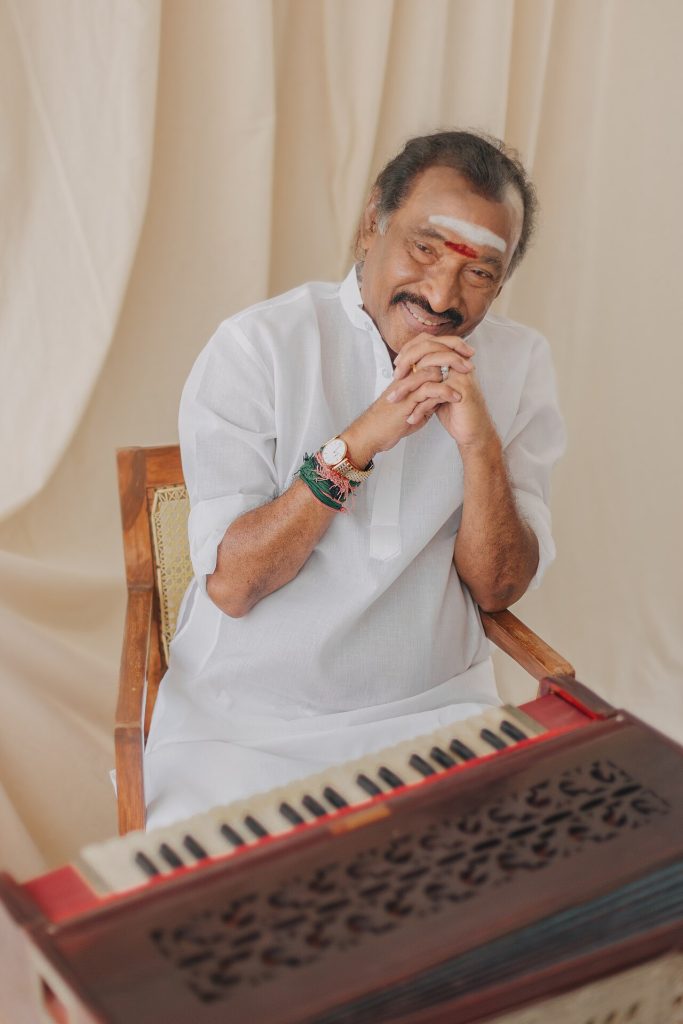
CHENNAI:
Tamil cinema has lost one of its most recognisable musical voices. Veteran composer and singer Deva, affectionately known as ‘Thenisai Thendral’, died on Saturday, October 17, at the age of 75. His death marks the end of a musical journey that spanned nearly four decades and more than 400 films across Tamil and other South Indian languages.
Deva occupied a distinctive place in Tamil film music. He entered the industry at a time when Ilaiyaraaja was at the height of his influence and A R Rahman was about to transform the musical landscape with Roja in 1992. Deva, then in his early forties, carved out his own space between these musical giants, building a reputation for catchy tunes, lively rhythms, accessible melodies and the unmistakable energy of Chennai’s gaana culture.
He was not merely a composer who supplied songs for films. His music became part of the identity of the stars and stories for which he worked. From romantic numbers and family entertainers to rousing introduction sequences and street-inspired gaana songs, Deva understood the pulse of the mass audience and created music that travelled far beyond cinema halls.
Annamalai and the Rajinikanth connection
One of Deva’s career-defining assignments came with Rajinikanth’s Annamalai (1992), directed by Suresh Krissna. The film marked the beginning of a celebrated association between the superstar and the composer, who stepped into a space previously dominated by Ilaiyaraaja in Rajinikanth’s films.
Annamalai gave Deva an opportunity to demonstrate that he could complement Rajinikanth’s screen persona with music that was both memorable and commercially effective. The film’s title-card music became especially iconic. Its association with Rajinikanth’s larger-than-life image has endured for decades, and the signature musical passage continues to be used and recognised even today.
The success of Annamalai was followed by Baashha (1995), another landmark in Rajinikanth’s career. Deva’s music helped build the film’s atmosphere and contributed to its lasting appeal. The collaboration continued with Arunachalam (1997), further cementing his place in the superstar’s musical history.
A composer who shaped the rise of Ajith and Vijay
If Rajinikanth gave Deva some of his most memorable mass moments, Ajith Kumar and Vijay benefited from his music during their formative years as leading stars.
Deva composed for Ajith in films including Aasai (1995), Kadhal Kottai (1996), Vaali (1999), Mugavari (2000), Citizen (2001) and Red (2002). These films covered romance, suspense, action and emotional drama, demonstrating his ability to adapt his music to different stories and the changing image of a young hero. Aasai, in particular, became an important early success in Ajith’s career.
His association with Vijay was equally significant. Deva composed for Rasigan (1994), Deva (1995), Vishnu (1995), Maanbumigu Maanavan (1996), Ninaithen Vandhai (1998), Priyamudan (1998) and Kushi (2000). His songs accompanied Vijay’s transition from a young romantic hero to a bankable commercial star. The music of Kushi, in particular, remains closely associated with the film’s youthful charm and enduring popularity.
Deva also worked with Kamal Haasan in films such as Avvai Shanmugi (1996) and Pammal K Sambandam (2002). The former showcased his ability to serve a comedy entertainer, while the latter brought his music to another of Kamal Haasan’s distinctive comic performances. His work across these star-driven films underlined his versatility in an industry where music often played a central role in a film’s commercial fortunes.
The man behind Tamil cinema’s gaana wave
For many listeners, Deva’s name will forever be linked with gaana music. Rooted in Chennai’s working-class neighbourhoods and street culture, the style brought colloquial language, earthy humour and infectious rhythms into mainstream cinema. Deva helped popularise this sound on a much wider scale, giving it a place alongside conventional film melodies.
His catalogue included songs that audiences could sing along to after a single hearing. He had a keen instinct for catchy hooks and rhythms that worked in theatres, at celebrations and in everyday life. While gaana became his most recognisable musical signature, Deva himself spoke of his love for melodies and his desire to explore different musical traditions. In a 2026 interview, he reflected on a career spanning more than 500 films and 36 years in the industry.
His career was not confined to Tamil cinema. Deva also composed for Telugu, Kannada and Malayalam films, and his work in Kannada cinema earned him a Filmfare Award for Best Music Director for Amrutha Varshini. He received the Tamil Nadu government’s Kalaimamani award in 1992 and a Tamil Nadu State Film Award for Best Music Director earlier in his career.
A musical legacy beyond generations
Deva’s contribution also extended beyond his own compositions. His son Srikanth Deva went on to become a music composer, while his brothers Sabesh and Murali formed the composing duo Sabesh-Murali. Even in his later years, Deva remained connected to changing musical trends, singing for younger composers including A R Rahman, Anirudh Ravichander, G V Prakash Kumar and Santhosh Narayanan.
His journey was a reminder that film music does not need to belong to only one tradition. At a time when Ilaiyaraaja’s orchestral richness was a dominant force and Rahman’s arrival was opening new sonic possibilities, Deva established a sound that was unmistakably his own. He understood the power of a simple, memorable tune and the excitement a signature musical phrase could generate when a star appeared on screen.
For generations of Tamil filmgoers, Deva’s music will remain inseparable from memories of Annamalai, Baashha, Aasai, Vaali, Ninaithen Vandhai and Kushi. His songs brought rhythm to the streets, romance to the screen and a distinctive musical identity to some of Tamil cinema’s biggest stars.
The man known as Thenisai Thendral may have fallen silent, but the beats and melodies he left behind will continue to play in the memories of Tamil cinema lovers.