


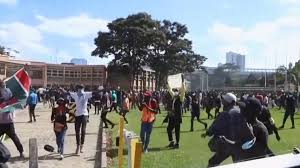
 Nairobi, July 22: Kenya’s volatile political landscape has been further destabilized as widespread protests against President William Ruto’s contentious finance bill continue to escalate. The protests, which initially erupted in response to the bill’s tax increases, have been marked by significant violence and unrest.**
The protests began a month ago and surged again on Tuesday, with demonstrators across the country calling for Ruto’s resignation. The crowds, fueled by frustration over rising living costs and police brutality, have clashed with law enforcement. Demonstrators have set fires, thrown stones, and chanted slogans such as “Ruto must go” and “Stop killing us.” The police response has been harsh, with teargas, water cannons, and even live ammunition being used. Tragically, one protester was shot dead and his body was paraded to a nearby police station.
The unrest is rooted in the 2024 finance bill, which proposed a $2.7 billion tax increase on essential items including sanitary towels, digital content, car ownership, and basic foodstuffs like oil and bread. This bill, aimed at addressing Kenya’s significant national debt, was met with intense public backlash. Over 39 protesters were killed in the initial demonstrations, with hundreds more injured, detained, or abducted by government forces.
In response to the unrest, Ruto has made concessions, retracting some of the most contentious elements of the finance bill and dismissing much of his cabinet. However, the protests have persisted, now demanding broader governmental reforms. The movement, predominantly led by Kenya’s youthful population and organized via social media, has grown into a powerful force demanding systemic change.
Caroline Kimeu, the Guardian’s East Africa global development correspondent, explains that the initial tax hikes were seen as a severe burden during an already challenging economic period. The public backlash was exacerbated by Ruto’s perceived prioritization of international obligations, such as Kenya’s controversial police mission to Haiti, over pressing domestic issues.
The situation has sparked intense scrutiny of the International Monetary Fund (IMF), which had reportedly pressured the Kenyan government to adopt austerity measures as a condition for accessing a $3.9 billion loan. Critics argue that Ruto’s focus on meeting IMF demands has overshadowed urgent national concerns, fueling further anger among Kenyans.
The second round of protests has uncovered deeper grievances about governance and economic inequality. Demonstrators, united by a shared sense of injustice, are pushing for a comprehensive overhaul of Kenya’s political system. Many feel that the government has long been out of touch with the needs of ordinary citizens and has failed to address systemic corruption and mismanagement.
Looking ahead, Ruto faces a precarious situation. Despite his efforts to placate protesters by making concessions and restructuring his administration, he is losing support across the country. The potential for continued violence and a crackdown on dissent raises fears of escalating disorder. However, there is also hope that the current unrest could pave the way for meaningful change, as public scrutiny of political leaders intensifies.
The crisis in Kenya highlights a nation at a crossroads, grappling with the intersection of economic hardship, political corruption, and the quest for justice. The coming days will be crucial in determining whether the protests will lead to a transformative shift or further descent into chaos.