


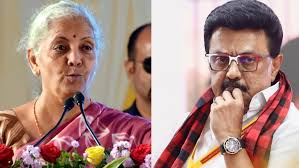
 Union Finance Minister Nirmala Sitharaman on Tuesday strongly rebutted Tamil Nadu Chief Minister M.K. Stalin’s criticism of the Union Budget 2026–27, calling his remarks “myopic and divisive” and asserting that the Budget includes several provisions that will directly benefit Tamil Nadu and its residents.
Stalin had accused the BJP-led central government of sidelining Tamil Nadu in the latest Budget. However, in a televised interview following the Budget’s presentation, Sitharaman described such claims as politically motivated and regrettable. She argued that key initiatives in the Budget — including infrastructure projects like high-speed rail links and sector-specific agricultural programmes — would bring real gains to the State. Targeted schemes for sandalwood and coconut farmers, she said, are expected to deliver substantial benefits to local agricultural communities.
Responding to Stalin’s references to historical Aryan–Dravidian narratives, the Finance Minister labelled such remarks “divisive,” insisting that they reflect an unhealthy mindset that should be condemned rather than promoted.
When asked why the BJP has yet to secure electoral success in Tamil Nadu, Sitharaman said the party is steadily expanding its base in the State and remains confident of future victories. “We are growing and we will win,” she emphasized, noting that even the **Congress — a major national party — has not formed a government in Tamil Nadu for over six decades.
On questions about whether the BJP was concerned about popular Tamil actor Vijay’s entry into politics, Sitharaman turned the spotlight back on the DMK, suggesting that its nervousness explains recent announcements of freebie schemes by the state government. She also alleged a deterioration in law and order in Tamil Nadu and a rise in drug abuse, claims that underscore the growing political tensions between the Centre and the state ahead of elections.
Defending the Budget more broadly, Sitharaman framed it as a strategic response to global economic challenges, including tariff disputes, geopolitical conflicts and volatile markets. She said stability was a priority and described the Budget not merely as a yearly financial plan, but as part of India’s broader long-term vision toward growth and development by 2047. “Reforms do not end with announcements — they are a continuous process,” she said, urging critics to evaluate the government’s performance holistically rather than focus on isolated Budget elements.