

2011: Competing ‘Free’ Promises in DMK & AIADMK Manifestos

- Tamil
- Hindi
- Malayalam
- Kannada
- Telugu
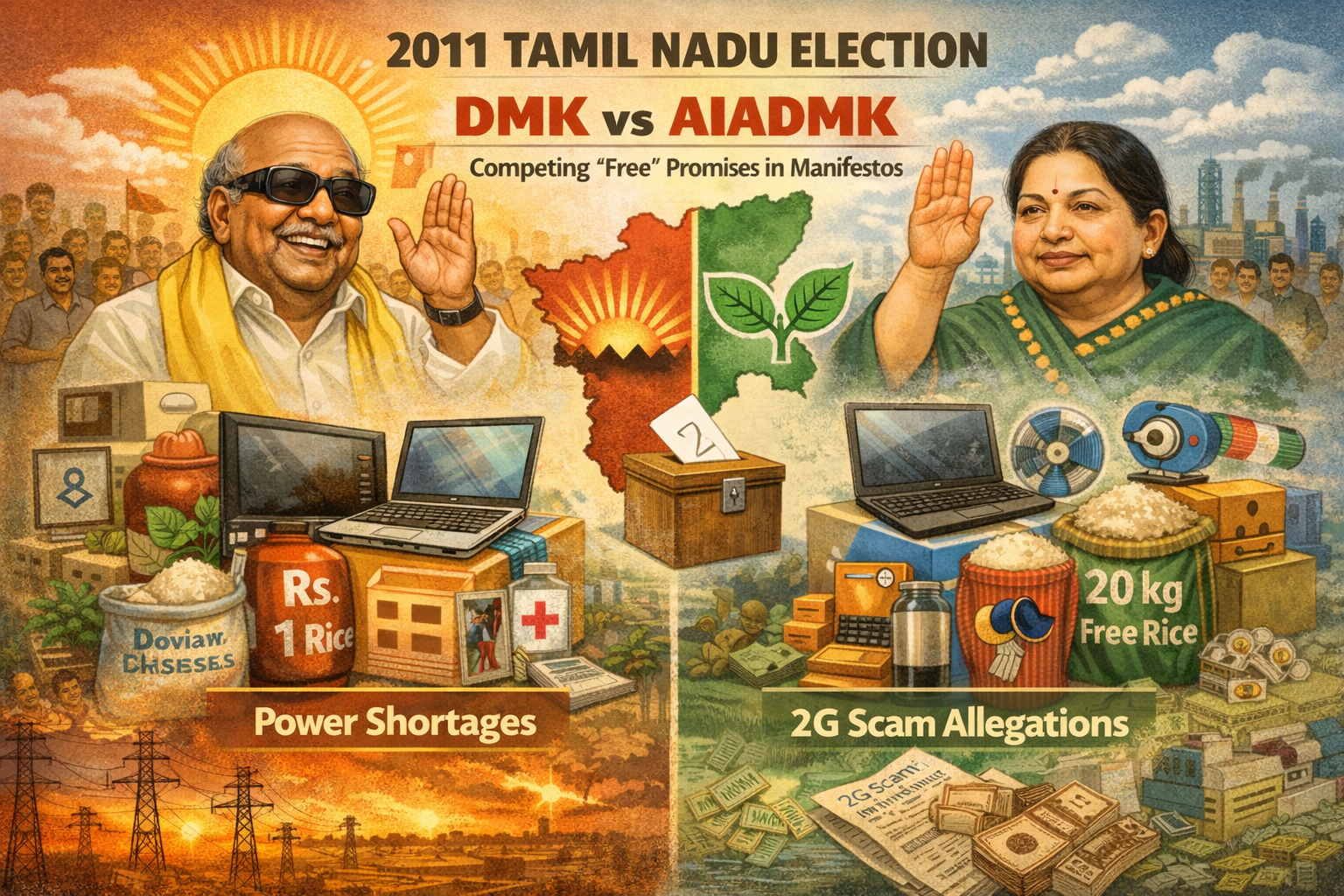
The 2011 Tamil Nadu Legislative Assembly election was one of the most consequential elections in the political history of Tamil Nadu. The election saw an intense political contest between the ruling Dravida Munnetra Kazhagam (DMK)led by M. Karunanidhi and the opposition All India Anna Dravida Munnetra Kazhagam (AIADMK) led by J. Jayalalithaa.
The election was significant not only because of the political rivalry between the two dominant Dravidian parties but also because it deepened the culture of competitive welfare politics that had emerged in the state since the mid-2000s. Both parties presented expansive manifestos promising welfare schemes, development initiatives, and governance reforms aimed at appealing to diverse social groups across the state.
Political Context Before the Election
The DMK government had been in power since 2006, governing with the support of alliance partners including the Indian National Congress. During this period, the government implemented several welfare programs such as the free colour television scheme, subsidised rice distribution, and social support initiatives for economically weaker families.
However, the political atmosphere leading into the 2011 election was heavily influenced by allegations of corruption and governance controversies. One of the most prominent issues dominating national and state politics was the 2G spectrum scam, which involved allegations related to telecom spectrum allocation during the tenure of the Manmohan Singh government at the Centre. Although it was a national issue, the involvement of DMK leaders in the controversy significantly affected public perception in Tamil Nadu.
Additionally, power shortages and rising electricity demand became major public concerns during this period. Frequent power cuts in several parts of the state created frustration among industrial units, businesses, and households.
These issues collectively contributed to a strong anti-incumbency sentiment against the DMK government as the election approached.
The DMK Manifesto: Continuity of Welfare and Development
The DMK manifesto for the 2011 election attempted to build upon the welfare policies introduced during its previous tenure. The party emphasized continuity, stability, and expansion of existing schemes rather than radical new promises.
One of the central commitments was the continuation of the free television scheme, which had been implemented during the DMK’s previous term. The party argued that this program had improved access to information and entertainment, particularly in rural areas.
The DMK also promised to strengthen the subsidised rice distribution system, ensuring that essential food items remained affordable for low-income households. The Public Distribution System (PDS) was projected as a key tool for maintaining food security and poverty reduction.
In addition, the manifesto included commitments to:
Expand healthcare infrastructure, particularly government hospitals and primary health centres.
Provide financial support and subsidies for farmers facing rising input costs.
Introduce assistance programs for small traders and micro-entrepreneurs.
Strengthen housing schemes for economically weaker sections.
Education and youth welfare formed another major pillar of the DMK’s campaign agenda. The party promised increased scholarships, expanded opportunities for higher education, and improvements in public school infrastructure. The government also proposed new initiatives aimed at enhancing skill development and employment opportunities for young people.
Infrastructure development was also emphasized, with proposals involving:
Road development projects
Urban housing initiatives
Drinking water supply improvements
Expansion of public transportation systems
Through these commitments, the DMK attempted to project itself as a party focused on inclusive development and long-term social welfare.
The AIADMK Manifesto: Expanding Welfare Promises
The AIADMK manifesto, however, captured massive public attention due to the scale and variety of welfare promises it introduced. Under the leadership of Jayalalithaa, the party crafted a manifesto that targeted multiple demographic groups simultaneously, including students, women, farmers, and low-income families.
One of the most widely discussed promises was the distribution of free laptops to students studying in government and aided institutions. The scheme was presented as a way to bridge the digital divide and provide young people with access to technology and educational resources.
The AIADMK also promised free household appliances, including mixer grinders and electric fans, aimed primarily at improving the quality of life for women managing household responsibilities.
Another major proposal involved 20 kilograms of free rice per month for ration card holders, which significantly expanded the scope of food security programs in the state.
The manifesto also contained several initiatives directed specifically at women, including:
Financial assistance schemes for marriage
Expanded self-help group programs
Increased economic support for women entrepreneurs
Farmers were another important constituency targeted by the AIADMK manifesto. The party promised:
Agricultural loan waivers
Improved irrigation infrastructure
Better access to agricultural subsidies and support systems
Addressing one of the most pressing issues in the state at the time, the AIADMK also pledged to resolve the power shortage crisis by expanding electricity generation capacity and improving power management.
In addition to welfare schemes, Jayalalithaa’s manifesto emphasized administrative reforms and anti-corruption measures. The party strongly criticised the DMK government over corruption allegations and promised stricter governance and improved law enforcement.
Campaign Narrative: Welfare, Corruption, and Governance
During the election campaign, the political narrative was shaped by three major themes:
Competing welfare promises between the two Dravidian parties
Corruption allegations against the DMK government
Public dissatisfaction with power shortages and governance issues
The AIADMK successfully used these issues to build a strong campaign against the ruling government, presenting itself as a party capable of restoring clean governance and administrative efficiency.
Election Results and Political Outcome
When the results of the 2011 Tamil Nadu Assembly election were declared, the AIADMK-led alliance achieved a sweeping victory, defeating the DMK government by a large margin.
The election reflected a powerful anti-incumbency wave across many parts of the state. The AIADMK alliance secured a decisive majority in the assembly, allowing Jayalalithaa to return as Chief Minister of Tamil Nadu.
Implementation of Welfare Schemes
After assuming power, the AIADMK government began implementing several promises made in its manifesto. Among the most notable were:
Free laptop distribution for students
Mixer, grinder, and fan distribution schemes
Expansion of food subsidy programs
Welfare initiatives aimed at women and rural families
These schemes significantly shaped the socio-economic landscape of the state and reinforced the importance of welfare programs in Tamil Nadu’s governance model.
Legacy of the 2011 Election
The 2011 election further strengthened the model of competitive welfare politics in Tamil Nadu. Both major Dravidian parties increasingly competed to offer large-scale social welfare programs alongside development initiatives.
This election also demonstrated how governance issues, corruption allegations, and welfare promises together influence voter behaviour in the state.
In the years that followed, election manifestos in Tamil Nadu continued to feature extensive welfare commitments. As a result, the 2011 election is widely regarded as another milestone in the evolution of policy-driven and welfare-oriented electoral politics in Tamil Nadu.