


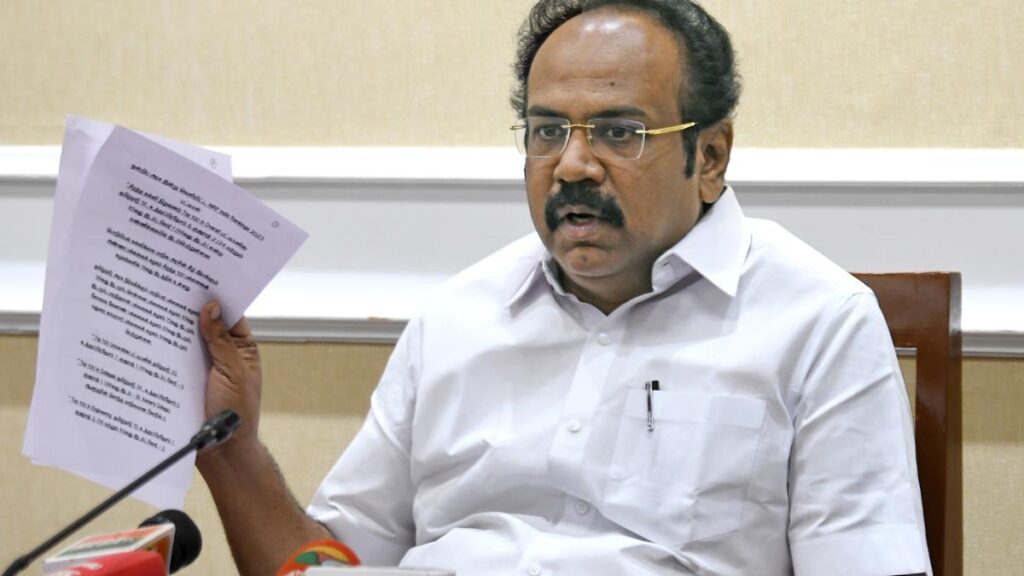
Chennai, June 17:
Former Tamil Nadu Finance Minister Thangam Thennarasu has strongly criticised the white paper presented by the Tamilaga Vettri Kazhagam (TVK), questioning its projections on state finances, debt levels, and welfare expenditure commitments.
Speaking to the media, he said the document highlights financial constraints prematurely while discussing the feasibility of implementing new welfare schemes under the current economic conditions.
Thennarasu argued that the white paper itself suggests difficulty in launching new development projects due to an existing fiscal deficit. He noted that such statements, made at the outset, reflect a constrained financial outlook and raise doubts about the ability to implement large-scale programmes effectively.
He also commented on the timing of the white paper, stating that it was released ahead of the Governor’s address, whereas traditionally, new policy announcements are expected during such formal legislative occasions. According to him, the document appears to pre-emptively signal that no major new initiatives should be expected from the government in the near future.
The former minister made sharp projections regarding Tamil Nadu’s future debt trajectory, claiming that if the Tamilaga Vettri Kazhagam were to complete a five-year term in power, the state’s debt could rise significantly. He challenged the party to demonstrate fiscal discipline by reducing borrowing levels compared to previous administrations, adding that he would be willing to step down from his position if such claims were proven otherwise.
Thennarasu also presented historical comparisons of Tamil Nadu’s debt levels, citing figures from past decades. He stated that the state’s debt stood at around ₹57,000 crore during the 2006–07 period, rose to nearly ₹1 lakh crore by 2011–12, increased to ₹4.85 lakh crore at the end of the AIADMK regime under Edappadi K. Palaniswami, and reached approximately ₹10 lakh crore during the current administrative cycle, according to his assessment.
He further argued that proposed welfare schemes, including free gas cylinders, women’s financial assistance programmes, unemployment support, and free transport initiatives, would significantly increase fiscal burden. He questioned whether such expenditures are classified under capital or revenue spending and raised concerns about long-term financial sustainability.
Thennarasu also pointed out that revenue stress is being driven by structural factors, including Goods and Services Tax (GST) implications, while noting that such issues were not adequately addressed in the white paper. He added that subsidies such as free electricity for farmers and free bus travel for women contribute significantly to recurring expenditure.
Defending welfare schemes implemented by the current government, he questioned whether programmes like women’s monthly assistance and free bus travel could realistically be withdrawn, suggesting that such commitments become permanent fiscal obligations once introduced.
He concluded by challenging TVK to fulfil its electoral promises, citing examples such as cooperative farm loan waivers. He alleged that while full loan waiver promises were made, only partial relief has been provided so far, raising questions about implementation consistency.