

2021: Competing Visions of Development & Welfare

🌐 Translate ▾
- Tamil
- Hindi
- Malayalam
- Kannada
- Telugu
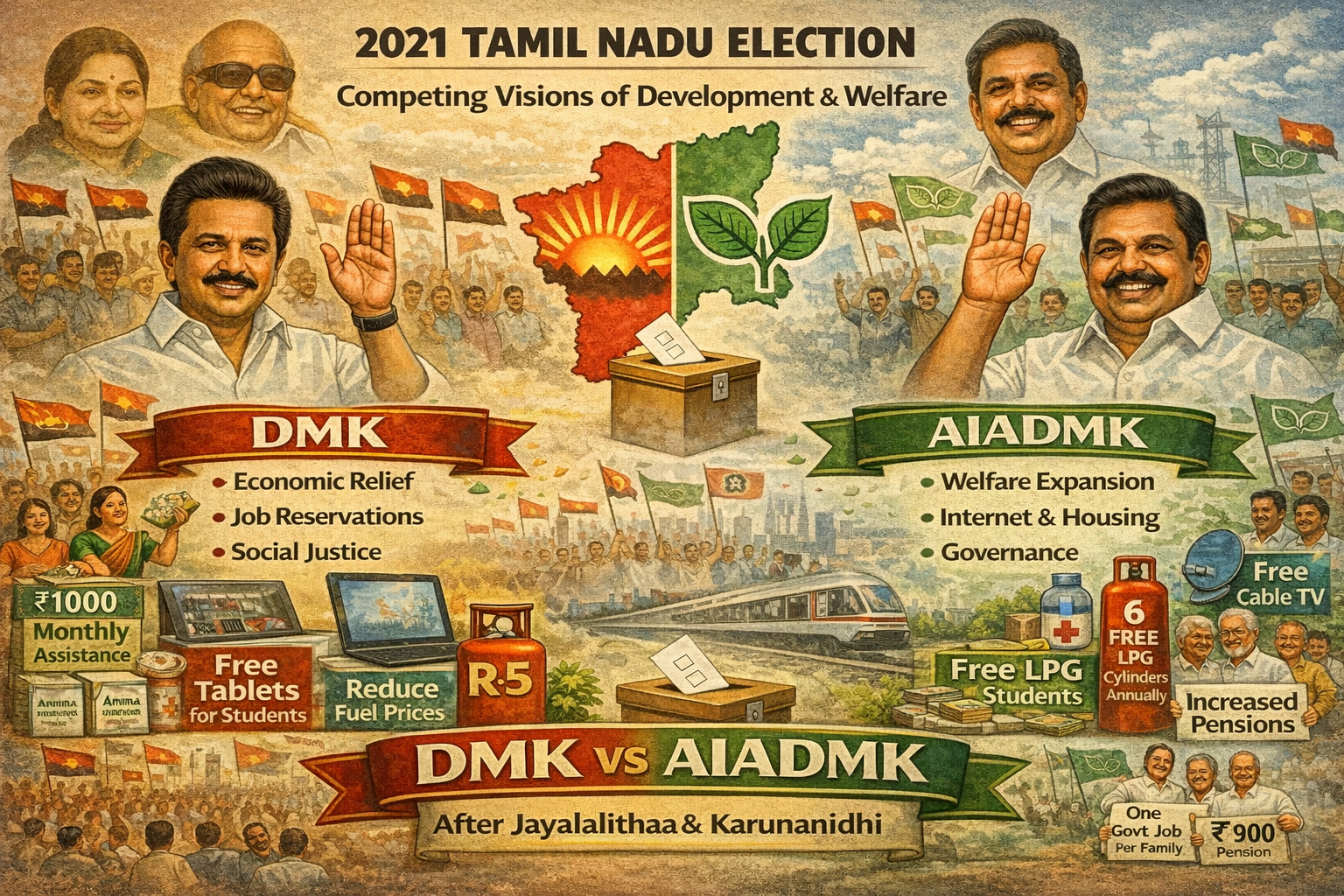
The 2021 Tamil Nadu Legislative Assembly election marked a historic and transformative phase in the political landscape of Tamil Nadu. For the first time in several decades, the election was conducted in the absence of the two towering personalities who had dominated state politics for years — J. Jayalalithaa and M. Karunanidhi. Their passing created a new political environment where the leadership mantle shifted to the next generation of Dravidian leaders.
The main contest was between the Dravida Munnetra Kazhagam (DMK) led by M. K. Stalin and the All India Anna Dravida Munnetra Kazhagam (AIADMK) headed by Edappadi K. Palaniswami. The election thus represented a generational transition in Tamil Nadu politics, while still maintaining the long-standing rivalry between the two major Dravidian parties.
Political Context Before the Election
The 2021 election took place during an extraordinary period marked by the global COVID-19 pandemic, which had caused economic disruption, public health challenges, and job losses across the state. The pandemic significantly influenced political discourse, as voters expected governments to focus on healthcare infrastructure, economic recovery, and social security.
During the campaign period, both major parties sought to address the economic hardships faced by households and businesses. Welfare promises, employment initiatives, and relief measures became central themes in the manifestos.
The election also reflected the continuing importance of Dravidian ideology, regional identity, and social justice policies, which have historically shaped Tamil Nadu’s political culture.
The DMK Manifesto: Social Justice and Economic Relief
The DMK manifesto for the 2021 election focused on themes of social justice, economic relief, and employment generation. The party promised a range of welfare programs designed to address the financial challenges faced by ordinary citizens following the pandemic.
One of the most notable proposals was 75 percent reservation in private sector jobs for local residents in Tamil Nadu. The DMK argued that such a policy would ensure that industrial growth in the state translated into employment opportunities for local youth.
The party also promised a series of direct financial assistance schemes for women, recognizing their role in managing household finances and supporting family welfare. These measures were designed to strengthen economic security among low-income families.
Additional commitments included:
Reduction in fuel prices to reduce the cost of living
Expanded welfare support for farmers and agricultural workers
Programs aimed at improving social security for informal sector workers
Education, Youth, and State Rights
Education and youth development formed another central pillar of the DMK manifesto. The party proposed the distribution of free tablets for students, expansion of public school infrastructure, and increased investment in government colleges and universities.
The manifesto also emphasized policies aimed at reducing unemployment and improving skill development opportunities for young people.
A key political issue during the campaign was opposition to the National Eligibility cum Entrance Test (NEET), the national medical entrance examination. The DMK argued that NEET disadvantaged students from rural and government school backgrounds. As a result, the party pledged to continue efforts to seek exemption from the exam and protect state rights in education policy.
Infrastructure & Industrial Development
Alongside welfare programs, the DMK manifesto also focused on long-term economic development. The party promised to strengthen industrial growth and urban infrastructure in major cities including Chennai, Coimbatore, and Madurai.
Key proposals included:
Expansion of industrial corridors and manufacturing clusters
Modernisation of public transportation systems
Investments in urban housing, water supply, and sanitation infrastructure
Through these policies, the DMK attempted to project a vision of balanced development combining welfare support with economic growth.
The AIADMK Manifesto: Welfare Expansion & Governance Continuity
The AIADMK manifesto for the 2021 election included 164 promises covering multiple sectors, reflecting the party’s strategy of appealing to diverse social groups across the state.
Among the most prominent proposals was the distribution of six free LPG cylinders annually to eligible families, which aimed to reduce household expenses. The party also promised waiver of education loans, addressing the concerns of students and families burdened by rising education costs.
Another notable commitment was the provision of free internet data for college students, highlighting the growing importance of digital connectivity in education and employment.
The AIADMK manifesto also included several welfare initiatives such as:
One government job per household
Increased pensions for elderly and differently-abled citizens
Housing for all families through expanded government housing schemes
Free cable television services for households
These proposals sought to reinforce the party’s long-standing emphasis on welfare delivery and social support programs.
Welfare Programs for Women and Farmers
Women and farmers continued to be key voter groups targeted by both major parties. The AIADMK promised expanded financial assistance programs for women’s self-help groups, support for female entrepreneurs, and additional welfare schemes aimed at improving household economic stability.
Farmers were promised increased subsidies, improved irrigation infrastructure, and expanded crop insurance schemes to reduce the risks associated with agriculture.
The manifesto also highlighted initiatives to strengthen rural infrastructure and promote agricultural productivity across the state.
Campaign Narrative and Electoral Atmosphere
The 2021 election campaign was marked by an intense political atmosphere as both parties sought to position themselves as the most capable of leading the state in a post-pandemic era. The DMK campaign emphasised administrative reform, economic recovery, and social justice, while the AIADMK highlighted its record in governance and welfare implementation.
Public debates focused on issues such as employment opportunities, rising living costs, education reforms, and healthcare infrastructure. Political rallies, media campaigns, and grassroots outreach programs played a major role in shaping voter perceptions across the state.
Another defining feature of the election was the growing role of digital campaigning and social media communication, which allowed political parties to reach younger voters more effectively than in previous elections.
Election Results and Historic Transition
When the results of the 2021 Tamil Nadu Assembly election were announced, the DMK-led alliance secured a decisive victory, ending ten years of AIADMK rule in the state.
With this victory, M. K. Stalin assumed office as the Chief Minister of Tamil Nadu, marking the beginning of a new political era for the state. His leadership represented the continuation of the Dravidian political tradition while also signalling a shift toward a new generation of governance.
Legacy and Political Significance
The 2021 election demonstrated that welfare politics continues to play a central role in Tamil Nadu’s electoral system, but it also highlighted the increasing importance of economic policy, governance reforms, and infrastructure development.
Both major parties presented comprehensive manifestos combining social welfare programs, economic growth strategies, and institutional reforms. This indicated that voters were evaluating political parties not only on ideological grounds but also on the practical benefits and development opportunities they promised.
The election also symbolised the transition from the era of Karunanidhi and Jayalalithaa to a new phase of leadership under M. K. Stalin and Edappadi K. Palaniswami, reshaping the future trajectory of Tamil Nadu politics.