

2026: DMK, AIADMK and TVK Roll Out Competing Welfare Agendas

- Tamil
- Hindi
- Malayalam
- Kannada
- Telugu
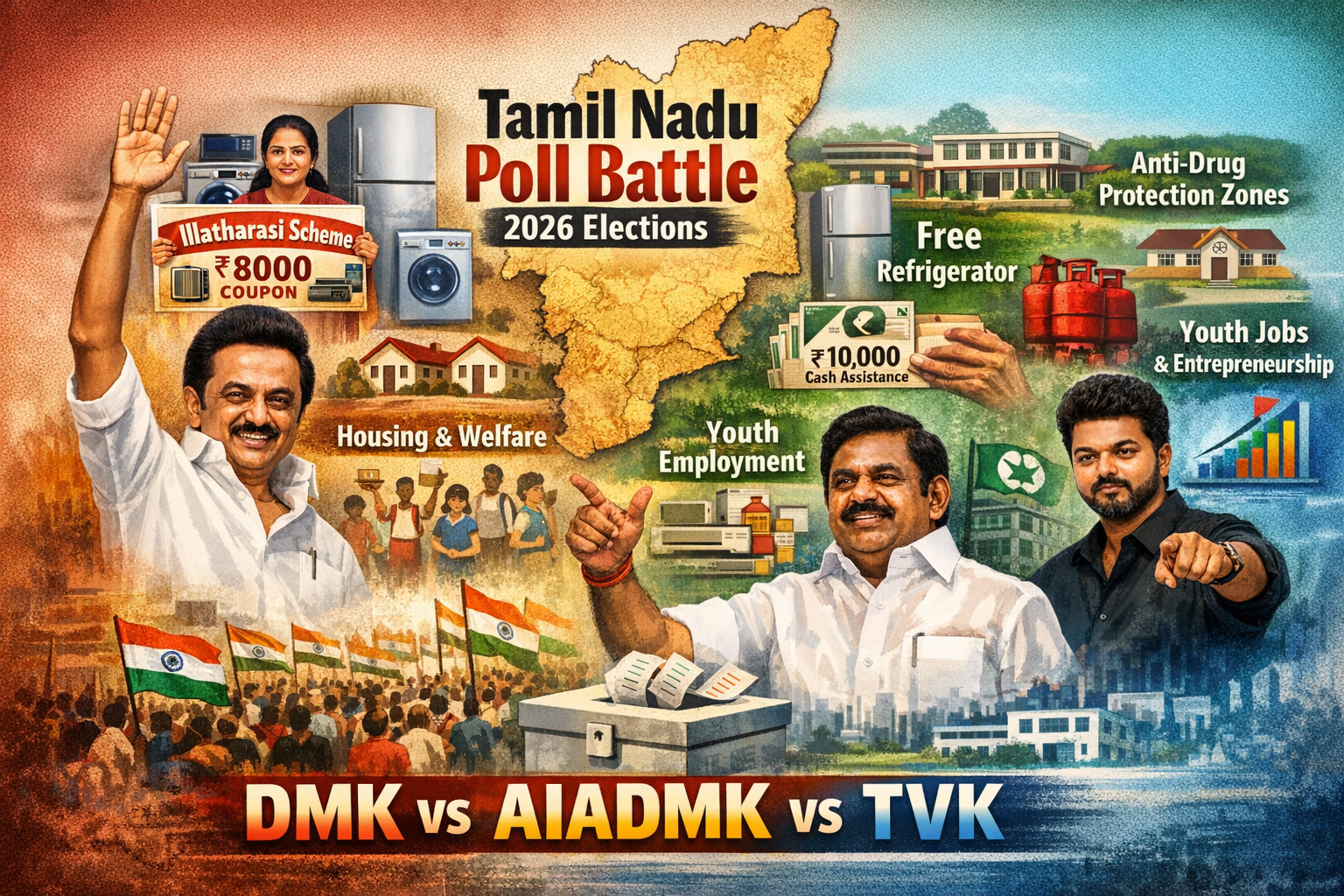
The political landscape in Tamil Nadu intensified as major parties — the ruling Dravida Munnetra Kazhagam (DMK), the Opposition All India Anna Dravida Munnetra Kazhagam, and Tamilaga Vettri Kazhagam — unveiled expansive and competing manifestos ahead of the 2026 Assembly elections, each seeking to consolidate support across key voter segments
The DMK, led by Chief Minister M K Stalin, presented its “Dravidian Model 2.0” vision, placing strong emphasis on welfare expansion, education and inclusive economic growth. Among its major promises, the government will extend the flagship breakfast scheme up to Class 8, benefiting nearly 19 lakh students. In a significant move targeting women voters, the monthly assistance under the Kalaignar Magalir Urimai Thogai scheme will be doubled to ₹2,000.
The party also announced plans to construct 10 lakh houses over five years and provide modern, meter-free pump sets to farmers receiving free electricity. In healthcare, the annual income eligibility for the State’s insurance scheme will be increased to ₹5 lakh, with coverage enhanced to ₹10 lakh. Dialysis facilities in government hospitals are set to be doubled, improving access to critical treatment.
Education and youth welfare form a core component of the DMK’s agenda, with enhanced financial aid of ₹1,500 per month under the Pudhumai Penn and Tamil Pudhalvan schemes. Additionally, laptops will be distributed to 35 lakh higher education students over five years. The party has also promised to fill 1.5 lakh government vacancies without delay, signalling a renewed push for employment generation.
Farmers and allied sectors have been given notable attention, with procurement prices for paddy and sugarcane proposed at ₹3,500 per quintal and ₹4,500 per tonne respectively, alongside a ₹5 per litre hike in milk procurement prices.
Social welfare measures include increasing old-age pensions to ₹2,000 and assistance for persons with disabilities to ₹2,500, while fishermen will receive ₹12,000 as relief during the ban period.
A standout feature of the DMK manifesto is the newly announced “Illatharasi” scheme. Under this initiative, homemakers from non-income-tax-paying families will receive ₹8,000 coupons to purchase household appliances such as televisions, refrigerators and washing machines, with an option to exchange old goods. M K Stalin described the scheme as a highlight of the manifesto, aimed at easing domestic financial burdens and strengthening outreach among women voters.
Meanwhile, the AIADMK, led by General Secretary Edappadi K Palaniswami, released a manifesto featuring 297 promises, heavily focused on welfare measures and subsidies. Key announcements include free refrigerators for ration cardholders, a one-time assistance of ₹10,000 to families, and a monthly financial support of ₹2,000 under the “Kula Vilakku” scheme.
The AIADMK has also promised free bus travel for men, expansion of housing under the “Amma Illam” scheme, and an increase in employment days under the rural job programme to 150 days. Additional measures include waiving education and farm loans, providing three free LPG cylinders annually, and enhancing pensions for vulnerable groups to ₹2,000.
The party further pledged targeted schemes for various sections, including subsidies for working women to purchase two-wheelers, financial assistance for unemployed youth, and welfare measures for fishermen, weavers and street vendors. Edappadi K Palaniswami also emphasised the need for greater financial autonomy for states, calling for increased devolution of central funds and protection of Tamil Nadu’s fiscal share.
Entering the fray with a youth-centric agenda, TVK president Vijay outlined a manifesto focused on employment, education and social reform. A key highlight is the creation of “anti-drug protection zones” in all schools and colleges, aimed at ensuring a drug-free environment for students.
The TVK manifesto promises monthly assistance of ₹4,000 for graduates and ₹2,000 for diploma holders, alongside structural reforms to ensure timely conduct of government examinations.
The party has also proposed a “Local Employment for Local People” policy, targeting 75 per cent job reservation for residents of Tamil Nadu.
In a bid to promote entrepreneurship, TVK announced the “Creative Entrepreneurs Scheme,” which aims to transform 1.5 lakh creators into business owners and establish 500 creative schools across the State. Vijay said the vision is to shift youth from job seekers to job creators, positioning Tamil Nadu as a hub for innovation.
With all three parties rolling out ambitious and welfare-driven manifestos, the stage is set for a high-stakes electoral contest, with voters expected to weigh competing promises on economic growth, social security and governance models in the weeks leading up to the polls.