

Ambattur: Where Factories Vote and Flats Follow

- Tamil
- Hindi
- Malayalam
- Kannada
- Telugu
Constituency No. 8 | Chennai District | General
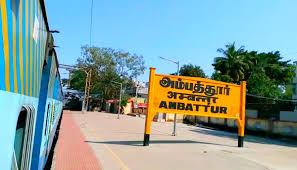
Ambattur does not announce its politics with banners. It produces them. This is a constituency shaped less by spectacle and more by shift timings, wage cycles, commuter trains, and apartment association notices. It is one of Chennai’s most industrially consequential seats, where the ballot is influenced as much by payrolls and public transport as by party manifestos.
Ambattur’s politics is industrial, intensely urban, and quietly decisive.
Industry as Identity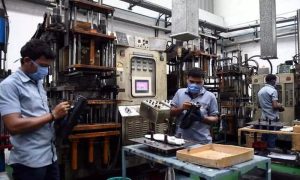
At the heart of Ambattur stands the Ambattur Industrial Estate, one of Asia’s largest industrial clusters. Decades old, it houses manufacturing units, MSMEs, auto ancillaries, electrical goods makers, and logistics operations that employ tens of thousands.
Factories define daily rhythm. Sirens mark time. Shift changes move crowds. Tea stalls fill, buses swell, trains empty and refill. Politics here is inseparable from employment stability, labour regulation, and industrial peace.
Ambattur’s economy is not aspirational alone; it is operational.
Lakes, Layouts, Lives
Beyond factories stretch dense residential layouts. Once peripheral housing colonies have matured into packed neighbourhoods with apartments, independent houses, and rental clusters for industrial workers and IT commuters.
Key public anchors include:
Korattur Lake, a crucial water body and flood buffer whose maintenance has become a recurring civic test.
The Ambattur–Avadi railway corridor, binding the constituency to Chennai’s suburban spine.
Local temples, churches and mosques embedded within residential grids, serving both faith and fellowship.
When lakes hold, roads survive. When they don’t, memory lingers for election cycles.
From Estate to Electorate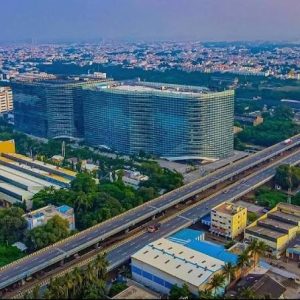
Ambattur’s transformation from industrial suburb to full-fledged urban constituency altered its voter profile. Alongside factory workers stand middle-income professionals, small entrepreneurs, traders, transport workers, and a growing salaried class commuting toward the city’s IT and service corridors.
This mix produces a distinctive political temperament:
Ideologically aware but not ideological.
Demanding on civic delivery.
Sensitive to transport, drainage, and public safety.
Urban consolidation has made Ambattur less volatile, but more exacting.
The Electoral Ledger:
Ambattur’s recent results reflect tightening contests followed by consolidation.
2011
Winner: V. S. Babu (AIADMK) — 80,134 votes
Second: S. Balaji (DMK) — 65,432 votes
Third: M. Selvam (DMDK) — 22,908 votes
Margin: 14,702 votes
2016
Winner: Alexander V (AIADMK) — 94375 votes
Second: Aassan Maulaana (INC) — 76877 votes
Third: Sekar K N (PMK) — 16,635 votes
Margin: 17,498 votes
2021
Winner: Joseph Samuel (DMK) — 1,14,554 votes
Second: V. Alexander (AIADMK) — 72,408 votes
Third: R.Anbu Thenarasan(Naam Tamilar Katchi) — 22,701 votes
Margin: 42,146 votes
The verdict widened decisively. Organisational depth prevailed.
The sitting MLA did not enter the cabinet, but urban constituencies often value execution over elevation.
Transport Is Politics
Few issues resonate in Ambattur as consistently as mobility.
Suburban rail reliability, station upkeep, bus frequency, last-mile connectivity, and road maintenance shape everyday experience. Industrial workers depend on punctual transport. Delays translate directly into lost wages or disciplinary penalties.
Metro extensions are watched closely, not as prestige projects but as practical relief.
In Ambattur, transport policy is social policy.
Flood Memory and Municipal Muscle
Parts of Ambattur remain vulnerable during heavy rainfall. Drainage capacity, lake desilting, and storm-water channel maintenance are therefore not seasonal talking points; they are permanent benchmarks.
Apartment associations and resident welfare groups act as informal watchdogs. Complaints escalate quickly. Response time matters more than rhetoric.
Urban voters here do not forget waterlogged streets easily.
Workforce and Welfare
Despite its industrial character, Ambattur carries significant welfare dependence.
Public distribution efficiency
Health centre accessibility
School infrastructure
Affordable housing delivery
These influence loyalty among working-class voters. Welfare schemes are evaluated through outcome, not announcement.
At the same time, the salaried class demands predictability rather than populism.
Balancing these constituencies is the representative’s real challenge.
What Decides Here
Three determinants dominate Ambattur’s electoral calculus:
Employment Stability
Industrial peace and policy clarity reassure voters.
Urban Services
Drainage, transport, waste management and street maintenance decide perception.
Administrative Responsiveness
Accessibility often outweighs ideology.
Margins expand when systems work. They contract when systems stall.
Closing Frame
Ambattur wakes early, works long, and votes late.
Its factories hum, its trains carry, its lakes wait to be respected. Politics here is neither theatrical nor sentimental; it is transactional, structured, and rooted in daily life.
When Ambattur votes, it does so with the logic of an assembly line: steady, precise, and unforgiving of error.