


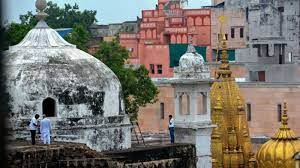
 The Archaeological Survey of India (ASI) report on the Gyanvapi mosque complex revealed that a pre-existing structure appeared to have been destroyed in the 17th century, and “part of it was modified and reused,” adding that based on scientific studies, it can be said that there “existed a large Hindu temple prior to the construction of the existing structure.”
The ASI also said the “western wall of the existing structure is the remaining part of a pre-existing Hindu temple”.
“The Arabic-Persian inscription found inside a room mentions that the mosque was built in the 20th regnal year of Aurangzeb (1676-77 CE). Hence, the pre-existing structure appears to have been destroyed in the 17th century, during the reign of Aurangzeb, and part of it was modified and reused in the existing structure. Based on scientific studies/surveys carried out, the study of architectural remains, exposed features and artefacts, inscriptions, art and sculptures, it can be said that there existed a Hindu temple prior to the construction of the existing structure,” the ASI said in its report.